
Most dental practices already know they need SEO. What trips people up isn’t the “why.” It’s figuring out which dental SEO strategies actually move the needle versus which ones are just busywork an agency bills you for every month.
The 15 Dental SEO Strategies
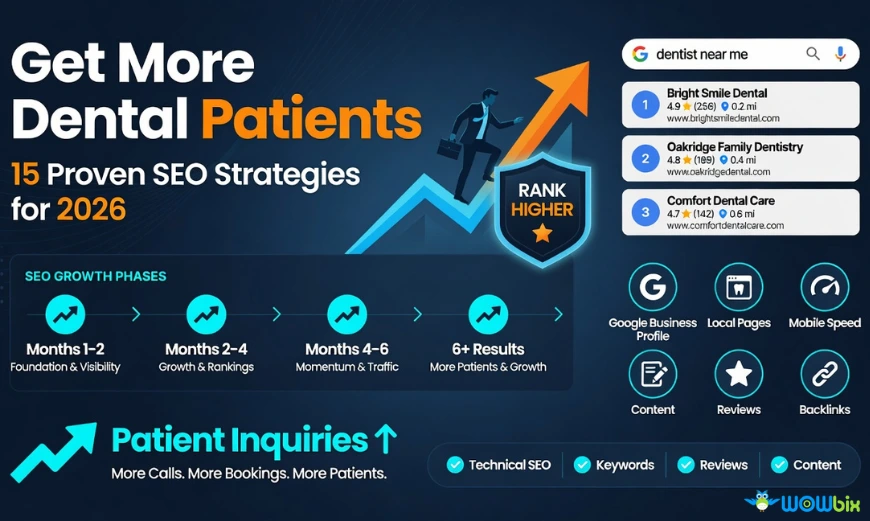
Below are 15 strategies that are actually worth your time in 2026, broken into what matters most first.
1. Fix Your Google Business Profile Before Anything Else
Before touching your website, get your Google Business Profile in order. Correct category (Dentist, not just “Health”), consistent NAP (name, address, phone) across the web, real photos of your office and team, and a complete services list. This single profile often drives more new-patient calls than the website itself, especially for “near me” searches. For a deeper breakdown of how this connects to Google Maps rankings, see our guide on local SEO for dentists.
2. Build Dedicated Pages for Every Service
Don’t cram “Botox, Invisalign, implants, and whitening” onto one page. Search engines, and patients, respond better to dedicated, in-depth pages for each core service. If implants are a growth area for your practice, a standalone page built around real patient questions performs far better than a paragraph buried on your homepage. Our dental implant marketing guide walks through exactly how to structure these pages for both rankings and conversions.
3. Target Long-Tail, Intent-Rich Keywords
“Dentist” is nearly impossible to rank for and attracts the wrong kind of traffic anyway. Long-tail phrases like “emergency dentist open Saturday [city]” or “same-day dental crowns near me” convert far better because they match exactly what someone is about to do: book an appointment.
4. Create City and Neighborhood-Specific Landing Pages
If you serve multiple towns or neighborhoods, build separate pages for each, not just a “Service Areas” list. A dedicated page for “Dentist in [Neighborhood]” with unique content, testimonials, and local landmarks referenced will consistently outrank a generic areas-served page.
5. Prioritize Mobile Page Speed
Most dental searches happen on a phone, often from someone in pain looking for the fastest possible appointment. A slow-loading site loses that patient to the next result. Compress images, use a fast host, and cut unnecessary plugins.
6. Write Content That Answers Real Patient Questions
Skip generic “5 tips for healthy teeth” posts. Instead, answer the exact questions patients type into Google before booking: “does insurance cover a root canal,” “how long does teeth whitening last,” “what to expect at first visit with a new dentist.” This is where most dental SEO tips either work or fail. Specificity wins.
7. Get Deliberate About Review Generation
Reviews are one of the strongest ranking and conversion signals you have. Set up a simple post-visit text or email asking satisfied patients to leave a Google review, and make sure your front desk asks in person too. Volume matters, but recency matters just as much. A steady trickle of reviews outperforms a burst that goes stale.
8. Build Real, Relevant Backlinks, Not Just Any Backlinks
A link from a local news site, dental association, or chamber of commerce carries far more weight than a hundred low-quality directory links. If you’re unsure what actually counts as a valuable link in this space, our article on the real role of backlinks in dental SEO breaks down what actually moves rankings versus what’s just noise.
9. Optimize for “Near Me” and Voice Search
More patients are searching by voice through phones and smart speakers. These queries tend to be conversational, “who’s the best dentist near me that takes my insurance”, so your content should include natural, question-based phrasing, not just keyword-stuffed headers.
10. Use Schema Markup for Dental Practices
Structured data (LocalBusiness, Dentist, and FAQ schema) helps Google understand your hours, services, and reviews well enough to show rich snippets, like star ratings, directly in search results. This alone can meaningfully boost your click-through rate without changing your ranking position at all.
11. Publish Before-and-After Case Studies (With Consent)
For cosmetic services especially, real before-and-after photos with a short patient story build trust faster than almost any other content type. They also tend to earn natural shares and links, which supports the broader dental SEO strategy of building authority over time.
12. Keep an Active, Consistent Content Calendar
One blog post a month for six months beats twelve posts crammed into one month and then silence. Google favors sites that show consistent, ongoing signs of life, and consistency also compounds through internal linking, since each new post becomes another entry point to your service pages.
13. Don’t Neglect Technical SEO Basics
Broken links, duplicate title tags, missing meta descriptions, and orphaned pages quietly cap how well even great content can rank. A quarterly technical audit catches these issues before they become a bigger problem.
14. Decide Where SEO Fits Alongside Paid Ads
SEO and PPC aren’t either/or. They solve different problems on different timelines. If you’re trying to figure out how to split your budget between the two, our comparison on SEO vs. paid ads for dental practices lays out where each one delivers the best return.
15. Track What Actually Matters: Calls and Bookings, Not Just Rankings
Ranking #1 for a keyword means nothing if it doesn’t turn into booked appointments. Set up call tracking and form-tracking so you can see which pages and keywords are actually driving patients through the door, not just traffic.
Bringing It All Together
These dental SEO marketing tips work best as a system, not a checklist you do once and forget. Fix the foundation first (Google Business Profile, site speed, technical health), then build outward with content, local pages, and backlinks, and always tie it back to bookings rather than vanity metrics.
If you’re ready to strengthen your online presence, explore our dental SEO services to see how we help dental practices rank higher in local search and generate more patient inquiries.
Whichever path you take, the practices that win in 2026 aren’t the ones doing the most. They’re the ones doing the fundamentals consistently, month after month.