
Every dental practice owner asks this question eventually. You have a marketing budget, and you need to decide where it goes. Google Ads promises patients this week. SEO promises patients for years, but not this week.
The honest answer is neither one wins outright. But the numbers behind each channel tell you exactly when to lean on one over the other, and that’s what this guide breaks down.
SEO and Paid Ads Solve Different Problems
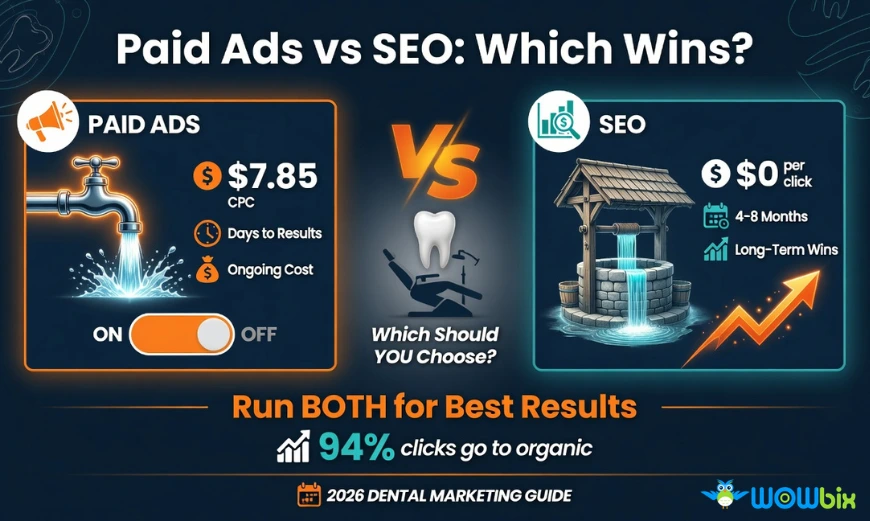
Paid ads for dentists work like a faucet. Turn the budget on, leads start flowing. Turn it off, they stop within hours. You’re renting visibility for as long as you keep paying.
SEO works more like a well. It takes time to dig, and the first few months can feel slow. Once you’re ranking, though, that traffic keeps showing up without a new invoice every month.
Neither approach is “better” in a vacuum. A new practice that opened last month and needs patients now has a different problem than a 15-year-old practice trying to dominate its city long-term. The right mix depends on which problem you’re actually solving.
What Each Channel Actually Costs Per Patient
This is where most practice owners get surprised. Dental keywords are some of the most expensive in all of Google Ads, not because dentists are bad at marketing, but because a single new patient is worth thousands over their lifetime, so everyone bids aggressively.
- Local SEO ($50–$150 per patient): Upfront costs for optimization, content, and citations require an investment, but organic clicks are “free.” Over time, high visibility in the Map Pack drives continuous volume without per-click charges.
- Google Ads ($15–$40 per click): At a typical healthcare conversion rate of 5% to 10%, acquiring a single patient from a $30 click actually costs between $300 and $600 per patient—making the true acquisition cost much higher than the per-click price suggests.
|
Factor |
Paid Ads (Google Ads) |
SEO |
|
Cost structure |
Pay per click, ongoing |
Upfront investment, then largely fixed |
|
Typical dental CPC |
~$5.90–$10.60 |
N/A (no per-click cost) |
|
Time to results |
Days |
Usually 4–8 months for competitive terms |
|
Cost after ranking/campaign matures |
Stays roughly the same |
Drops sharply per new patient |
|
What happens if you stop paying |
Traffic stops almost immediately |
Rankings persist, decay slowly |
Speed: Paid Ads Win, No Argument
If a new practice needs patients in the next two weeks, paid ads are the only real option. A campaign can go live same day, and a patient searching “emergency dentist near me” at 9 p.m. can be booking an appointment by 9:15. This is also why brand new practices usually pair ads with a fast, clean website launch rather than waiting for a full rebuild.
SEO simply can’t compete on this timeline. Even with aggressive content and technical work, ranking for competitive local terms takes months, not days.
Conversion Quality: This Is Where SEO Often Pulls Ahead
Speed isn’t the whole story. What matters more long-term is which visitors actually book.
Roughly 94 percent of clicks on Google go to organic results, with only about 6 percent going to paid ads, and the top organic result typically pulls a click-through rate near 39.8 percent, well above what the top paid result gets, according to industry click-through research. Patients who click an organic result made a deliberate choice. Nobody interrupted their scroll with an ad; they read your page, decided you looked credible, and clicked.
Paid Ads Can Convert, but Intent Varies
That doesn’t mean paid clicks are low quality. Dental PPC conversion rates can be strong, with some benchmarks showing double-digit conversion percentages for well-optimized campaigns. But a chunk of ad traffic is still price-shoppers and tire-kickers clicking the first thing they see, which is one reason average dental website conversion rates across both channels typically sit in the 2 to 5 percent range for the site overall. Strong reviews help close that gap either way, which is part of why review and reputation management tends to lift results for both channels at once.
When Paid Ads Are the Right Call
- You just opened and have zero rankings or reviews yet
- You’re launching a new service (Invisalign, implants) and want fast visibility while content and case pages get built
- A competitor is eating your local market and you need to show up now
- You want to test which keywords and offers actually convert before investing in long-term content around them
When SEO Is the Right Call
- You’ve been open more than a year and have some reviews and case history to build on
- You want a channel that doesn’t get more expensive as more competitors join Google Ads auctions
- You’re trying to build authority for your whole practice, not just one campaign
- You have good reviews, local SEO here can help you get leads faster
- Budget is limited and needs to work harder over 12+ months rather than 12 weeks, which is the whole argument for a dedicated dental SEO push once the basics are covered
The Approach That Actually Works: Running Both
Build SEO While PPC Delivers Immediate Leads
Most practices we’ve worked with don’t pick one. They run PPC hard for the first 3 to 6 months while the SEO groundwork (location pages, service pages, reviews, technical fixes) gets built underneath it. As rankings climb, ad spend gets dialed back on the keywords that are now ranking organically, and redirected toward newer service launches or competitive gaps. We break down how we evaluate agencies on this exact split in our best dental SEO companies rankings.
How the Budget Shifts Over Time
Here’s a rough example based on what we typically map out for a client: a practice spending $2,500 a month on ads generating 25 to 35 leads might, after 8 months of parallel SEO work, see organic search start contributing 10 to 15 of those leads on its own. That’s real budget freed up, not replaced, that can push into a new service line or a second location. If neither channel is producing patients right now, it’s worth reading through why practices stop getting new patients before adding more spend to a broken funnel.
A Realistic Expectation for SEO
One honest limitation worth naming: SEO results are never guaranteed on a timeline the way a signed ad contract is. Algorithm updates happen, competitors invest too, and a practice in a saturated metro like Los Angeles or NYC will simply take longer to rank than one in a smaller suburb. Anyone promising a guaranteed page-one spot in 60 days isn’t being straight with you.
FAQ
Is SEO or PPC better for a brand new dental practice?
PPC almost always makes sense first, since a new practice has no rankings or review history yet to rely on.
How long before dental SEO shows results?
Most competitive local terms take 4 to 8 months to see meaningful movement, sometimes longer in saturated cities.
Can I stop paid ads once SEO starts working?
Some practices reduce spend on keywords where they now rank well, but most keep a smaller PPC budget running for high-intent terms like “emergency dentist.”
Which one costs less per new patient long-term?
SEO typically costs less per patient after the first year, since there’s no per-click fee once you’re ranking.
Dental marketing doesn’t have to be an either-or decision, and figuring out the right split for your practice’s stage, budget, and market usually saves more money than guessing. If you want a second set of eyes on where your practice currently stands with either channel, reach out to our team and we’ll walk through the split before recommending anything.