
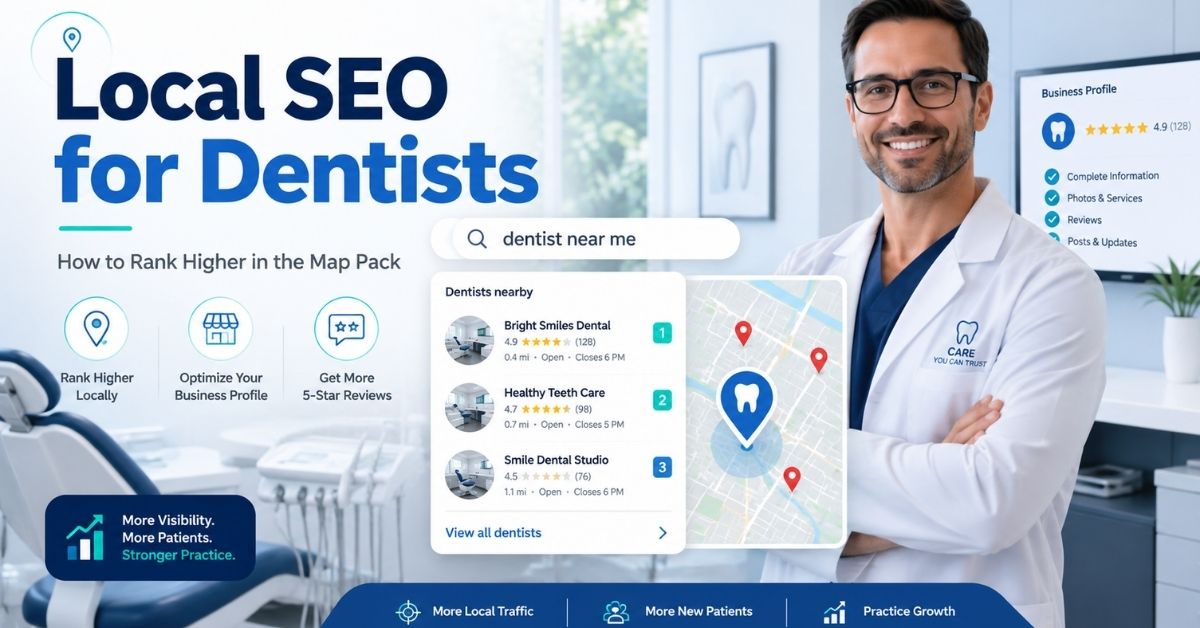
The majority of dental searches have local intent. When someone searches “dentist near me” or “emergency dentist open now,” they’re not researching. They’re looking for a practice they can call today.
The problem is, 40% to 44% of those clicks go to the Google Local Pack. That’s the map with three business listings at the top of search results. If you’re not in that top three, most potential patients never see you.
This is why local SEO for dentists matters more than any other strategy. Not general SEO. Not paid ads. Local search.
Wowbix has helped dozens of dental practices climb into the local pack over the past decade. The ones that do it right go from invisible to booked solid within six months. Here’s how.
- Why Local SEO Beats Everything Else
- Google Business Profile Is Everything
- Reviews Are Your Second Ranking Signal
- Local Citations: The Unglamorous Foundation
- Content That Targets Locally
- The Timeline: What to Expect
- Common Local SEO Mistakes
- What to Do First
- How Long Did This Take Your Competitors?
- Measuring What Matters
- The Compound Effect
- FAQ: Local SEO for Dentists
- Your Next Step
Why Local SEO Beats Everything Else
Google’s data is clear. Seventy-six percent of people who search for a local service visit a business within 24 hours. They’re ready to book. Not browsing. Not comparing options. Ready to call.
The local pack captures 40% to 44% of all clicks on local dental searches. Organic results get 22%. Paid ads get 10%.
This means one thing: if you’re not ranking in the local pack, you’re leaving money on the table.
A practice with a strong Google Business Profile, consistent reviews, and proper citations can fill its schedule almost entirely from local search. No paid ads. No referrals. Just patients finding you on maps.
The ROI is unmatched. Cost per patient acquisition through local SEO: 50 to 150 dollars once established. Compare that to Google Ads at 15 to 40 dollars per click, or traditional marketing at 300 to 500 dollars per patient.
Google Business Profile Is Everything
This is where local SEO lives or dies. Your Google Business Profile (GBP) is more important than your website. More important than content. More important than backlinks.
We audited 24 independent dental practices recently. Nineteen of them had at least one GBP problem costing them rankings.
The most common mistake? Incomplete profiles.
You need:
- Professional, well-lit photos of your practice, team, and treatment areas (30 minimum)
- Accurate hours that match reality
- Complete services list with secondary categories
- Correct phone number and address
- Website link that works
- Regular posts (one per week is ideal)
- A description that includes your specialties
Most practices do three of these. Great practices do all of them.
The second most common mistake? Wrong category selection.
Google lets you pick one primary category and nine secondary categories. The primary category is the heaviest ranking signal in the local pack.
Many practices pick “Dentist” as primary, then never add secondaries. If you do cosmetic work, add “Cosmetic Dentist.” If you do emergency services, add “Emergency Dental Service.” If you do pediatric dentistry, add “Pediatric Dentistry.”
Each secondary category you add signals to Google that you rank for related searches. A practice doing orthodontics needs “Orthodontist” or “Braces” as a secondary. A practice focused on implants needs “Dental Implants Periodontist.”
Reviews Are Your Second Ranking Signal
Reviews account for 24% of local pack ranking weight. Only GBP signals matter more.
But here’s what most practices get wrong: they chase total review count.
What actually moves rankings is review velocity. Practices gaining 15 to 30 new reviews per month outrank competitors with 500 old reviews.
After Google’s March 2026 update, recent reviews are weighted 2.3 times more heavily than older ones. A practice getting consistent new reviews will rank higher than a practice that built 300 reviews over five years and then stopped.
The other factor is star rating. Practices with 4.7+ stars generate 2 to 3 times the call volume of competitors with 4.2 stars. One half-point difference is significant.
How to build review velocity:
- Ask for reviews after every appointment
- Send review request emails one day after treatment
- Make it easy (provide a direct link to your Google review page)
- Respond to all reviews, positive and negative
- Target 10 to 20 new reviews per month
Most practices ask occasionally. Great practices build it into their workflow. Your front desk should ask every patient. Your hygienist should mention it. Your dentist should ask. Multiple touchpoints increase the ask rate.
Local Citations: The Unglamorous Foundation
A citation is any online mention of your practice name, address, and phone number. These exist on directories, review sites, and local business listings.
Google uses citation consistency as a local ranking signal. If your practice appears as “Smith Dentistry” on your website, “Smith Family Dentistry” on Yelp, “Dr. Smith Dental” on Healthgrades, and “Smith, DDS” on Zocdoc, Google can’t confirm that these are the same business.
Build NAP (name, address, phone) consistency across at least the top 20 directories:
High-authority directories:
- Google Business Profile
- Yelp
- Healthgrades
- Zocdoc
- Apple Maps
- Waze
- Better Business Bureau
Dental-specific directories:
- Dental.com
- Dentalplans.com
- Carington Dental
- Doctorly
Local business directories:
- Chamber of Commerce
- Local business listings specific to your city
Your NAP should be identical everywhere. Don’t abbreviate your name differently on different sites. Don’t use a different phone number. Don’t list an old address.
The effort required to clean this up is the biggest barrier to local SEO success. Most practices avoid it. That’s why it works as a ranking signal. Do what 80% of your competitors won’t.
Content That Targets Locally
Your website needs location-specific content. Not just one page about your services. Pages that target your specific city or neighborhood.
A practice in Denver needs:
- A “Dentist in Denver” page (not just a homepage)
- A “Pediatric Dentist in Denver” page (not just a pediatric page)
- An “Emergency Dentist in Denver” page
If you serve multiple neighborhoods:
- “Family Dentist in South Denver”
- “Dental Implants in Cap Hill”
- “Pediatric Dentist in Cherry Creek”
These pages don’t need to be long. 400 to 600 words is fine. Include local landmarks, references to the neighborhood, maybe a photo of your storefront or the area you serve.
Link these location pages to your Google Business Profile. Google rewards practices that create location-specific content.
The Timeline: What to Expect
Most practices expect results in 30 days. That’s not realistic.
Initial GBP optimization produces ranking movement within 1 to 2 weeks. You’ll see your profile show up higher in the local pack immediately.
True top-3 local pack positions for competitive keywords take 3 to 6 months of consistent work.
A solo practice in a low-competition market can hit ROI breakeven in 6 to 9 months. Competitive markets (big cities, multiple DSO competitors) take 9 to 12 months.
This timeline assumes consistent effort. If you optimize your GBP once and then do nothing else, you’ll see initial movement then plateau.
Common Local SEO Mistakes
Incomplete Google Business Profile
This is the number one mistake. Your profile has old hours, blurry photos, or missing information. Fix it completely. All of it.
Inconsistent NAP Across Directories
Your practice is “Michael Smith DDS” on your website, “Michael Smith Dentistry” on Yelp, and “Dr. Michael Smith” on Healthgrades. Google flags this as inconsistent. Clean it up.
Not Asking for Reviews
You have 12 reviews from two years ago. Your competitor down the street has 250 new reviews. They’ll outrank you. Build systematic review requests into your workflow.
Wrong Primary Category
You picked “Dentist” but you’re really a cosmetic dentistry practice. Switch your primary category to “Cosmetic Dentist.” You’ll rank better for cosmetic-related searches.
No Local Content on Your Website
Your website has generic dental information. Create location-specific pages. Target “Dentist in [Your City],” not just “Dentist.”
Ignoring the Map Pack Entirely
You’re focused on organic SEO and ignoring GBP optimization. The map pack is where the money is. Focus there first.
What to Do First
Start with your Google Business Profile. Open it. Go through every field.
Photos: Do you have 30+? Are they professional quality? Replace blurry ones. Add your team. Add your treatment areas. Add before and afters if you do cosmetic work.
Hours: Are they accurate? Do your hours match what’s on your website? Do they match your actual office hours? If you’re closed, does your profile say so?
Services: Have you listed all your services? Have you added secondary categories that match your specialties?
Description: Does it include local keywords? Does it mention what makes you different?
Posts: Have you posted anything in the last 90 days? Create one post per week.
After your GBP is perfect, build your citation profile. Get on the top 20 directories with consistent NAP. Ensure your name, address, and phone are identical everywhere.
Then focus on gathering reviews. Ask every patient. Make it part of your routine.
Once you have these three things in place, your local rankings will start climbing.
How Long Did This Take Your Competitors?
The practices ranking at position 1 for “dentist near me” didn’t get there in 30 days. They got there by doing the fundamentals correctly for 6 to 12 months.
They optimized their GBP. They got consistent reviews. They built clean citations. They created local content.
No shortcuts. No paid ranking schemes that claim to work. Just execution.
When you search for local dental keywords, the practices in positions 1, 2, and 3 are there because they did this work. They weren’t lucky. They did the work, and Google rewarded them.
You can do the same.
Measuring What Matters
Track these metrics in Google Search Console:
- Impressions: How many times did your practice appear in search results?
- Clicks: How many people clicked your listing?
- Click-through rate: What percentage of impressions turned into clicks? This tells you if your title and snippet are compelling.
- Average position: Where are you ranking on average for local keywords?
In Google Business Profile, track:
- Calls: How many calls did you get from your GBP?
- Directions: How many people requested directions?
- Website clicks: How many clicked through to your website?
These are your real metrics. Not ranking position (though that matters). Not website traffic. Not vanity metrics.
Track phone calls and form fills. That’s what matters. Everything else is a leading indicator.
The Compound Effect
Local SEO doesn’t work on a curve. It works exponentially.
Month one: Small improvements. A few more reviews. GBP optimized.
Month three: Visible movement. You’ve moved from position 8 to position 5.
Month six: Significant change. Top three for some keywords. Noticeable call increase.
Month nine: Market dominance. Top three for most local keywords. Booked months out.
The practices that succeed are the ones that stay consistent for the full nine to twelve months. The ones that optimize their GBP once and give up after three months never rank.
Build local SEO into your practice’s operations. Assign someone to manage reviews. Assign someone to manage your GBP. Make it part of monthly operations, not a one-time project.
Do this for 12 months. Then watch it compound for years.
Your Google Business Profile and your reviews become increasingly valuable as they age. The work you do now keeps working years from now.
FAQ: Local SEO for Dentists
How long does local SEO take for dental practices?
Most dental practices start seeing GBP ranking movement within 1 to 2 weeks of optimization. True top three local pack positions for competitive keywords take 3 to 6 months. In highly competitive markets with multiple DSO competitors, expect 9 to 12 months for dominance. The timeline assumes consistent effort on GBP, reviews, and citations every single month.
What’s the difference between local SEO and regular SEO?
Local SEO is about ranking in the Google Maps pack and local search results for “near me” queries. It’s driven by GBP signals, reviews, citations, and proximity. Regular SEO is about ranking in the organic results for broader keywords like “how much do implants cost.” They’re completely different systems with different ranking signals. Local SEO brings upto 44% of clicks. Organic gets 22%. Focus on local first.
How many reviews do I need to rank in the local pack?
There’s no minimum. A new practice with five reviews can rank if those reviews are recent and their GBP is perfect. What matters more is review velocity. Getting 15 to 30 new reviews per month ranks better than having 200 old reviews. A practice with 100 recent reviews outranks a practice with 500 reviews from years ago.
Should I pay for reviews?
Never. Google penalizes practices that buy reviews. Ask patients directly after their appointment. Make it part of your workflow. If you ask 10 patients per day and 20% leave reviews, that’s 40 reviews per month. That’s enough.
What’s the best way to get local citations for dentists?
Start with the big ones: Google Business Profile, Yelp, Healthgrades, Zocdoc, Apple Maps, Facebook. Then move to dental-specific directories like Dental.com and Dentalplans.com. Finally, add local business directories specific to your city. Your NAP must be identical everywhere. Don’t abbreviate your name differently on different sites. This takes time to audit and clean up, which is exactly why your competitors don’t do it.
Do I need a dental website if I have a strong Google Business Profile?
Your GBP gets you in the local pack. Your website converts visitors into patients. You need both. GBP is the front door. Website is the living room where you build trust. Without a website, visitors have nowhere to go to learn more about you.
How often should I post on my Google Business Profile?
At least once per week. Practices that post weekly rank higher than practices that post once per month. Posts don’t have to be long. A photo and a sentence is fine. Consistency matters more than depth.
What’s the best category to choose on Google Business Profile?
Your primary category should match your main service. A general dentist should use “Dentist.” A cosmetic-focused practice should use “Cosmetic Dentist.” An implant specialist should use “Dental Implants Periodontist.” Then add secondaries that match your other services. Each secondary category is a ranking signal for related searches.
Do I need schema markup for local SEO?
Schema markup helps Google understand your services, location, and reputation. It’s beneficial and you should add it, but it’s not the top ranking factor. Focus on GBP optimization, reviews, and citations first. Schema is the third priority, not the first.
Is local SEO for dentists different in competitive markets like Los Angeles?
Yes. Los Angeles has 50+ dentists competing for the same keywords. You need more aggressive strategy. Expect 9 to 12 months instead of 6. You need more reviews per month (target 30+). You need more local content targeting specific neighborhoods. You need consistent citations across 40+ directories instead of 20. The fundamentals are the same, but the execution needs to be stronger.
How do I measure if local SEO is working?
Track these in Google Business Profile: calls, direction requests, and website clicks. Track these in Google Search Console: impressions, clicks, and average position for local keywords. Most importantly, track phone calls and form submissions. A ranking that doesn’t produce calls is useless. Measure what matters.
Can I do local SEO myself or should I hire an agency?
You can do it yourself if you have time. The work is not complex. It’s just consistent. Update your GBP weekly. Ask for reviews. Build citations. Update your website. Do this for 12 months and you’ll rank. Most practice owners don’t have time, so they hire an agency. Either way works if you stay consistent.
What’s the cost of local SEO for a dental practice?
If you do it yourself, the only cost is time. If you hire an agency, expect 1,500 to 5,000 dollars per month depending on your market competitiveness. Consider ROI. A single new patient is worth 1,500 to 10,000 dollars depending on their treatment acceptance. Local SEO that brings five new patients per month pays for itself many times over.
Your Next Step
Open your Google Business Profile right now. Go through every field.
Does it look professional? Are your photos current? Are your hours correct? Is your description complete?
If you can’t answer yes to all of these, start there. That’s your first win.
Then run an audit of your citations. Google your practice name plus each major directory name. Is your NAP consistent? If not, update it.
Then implement a system for gathering reviews. Who will ask patients? How often? How will they ask? Make it specific and repeatable.
Thirty days from now, you should have a complete GBP, consistent citations, and a review gathering system in place.
Three months from now, you should start seeing local pack movement.
Six months from now, you should be competing in the top three for your local area.
That’s how local SEO works. Not magic. Fundamentals executed consistently.
If you want an audit of your current local SEO position or need help implementing these strategies, reach out. We work with dental practices to build local rankings that convert into scheduled patients.
One call from a patient who found you on Google Maps is worth more than any ranking position. Let’s get you there.