If two dental practices in the same city have similar websites, similar reviews, and similar content, one thing usually decides who outranks who: backlinks.
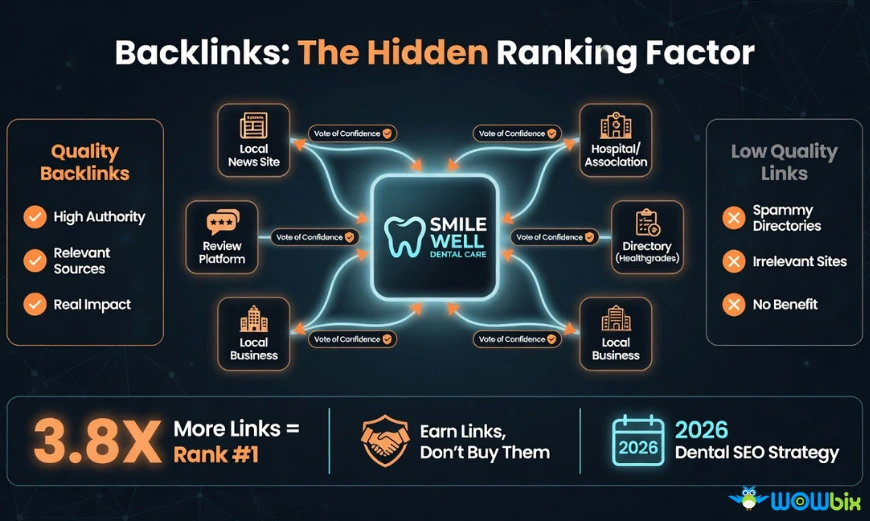
A backlink is simply a link from another website pointing to yours. Google treats each one as a small vote of confidence. The more of those votes you have from sites Google already trusts, the more it trusts you back.
That sounds simple. In practice, most dental practices either ignore backlinks completely or chase the wrong kind, which can do more harm than good.
What a Backlink Actually Looks Like
Say a local news site writes about a community dental health event your practice sponsored, and links to your website in the article. That’s a backlink.
So is a mention on a local dental association’s directory, a guest post you wrote for an industry blog, or a citation on Healthgrades. Each one tells Google that a real, established site vouches for yours.
Why This Still Matters in 2026
Backlinks Signal Trust
Google can’t taste your dental work or sit in your waiting room. It relies on signals, and links from credible sites remain one of the strongest ones it has.
An analysis of over a million Google search results by Ahrefs found that pages ranking in position one had roughly 3.8 times more backlinks than pages ranking two through ten. That gap alone explains why two similar dental websites can rank very differently.
Backlinks Bring Actual Patients, Not Just Rankings
A link isn’t just an algorithm signal. It’s also a doorway.
Someone reading a “best dentists in [city]” roundup on a local lifestyle blog, or a parenting forum discussing pediatric dentists, might click straight through to your site. That’s a warm visitor who already trusts the source that sent them.
Backlinks Help Google Find Your Pages Faster
Search engines crawl the web by following links. A new blog post or service page with zero links pointing to it can sit undiscovered for weeks.
One link from an already-indexed, frequently-crawled site can get a new page found and indexed within days instead.
Quality Beats Quantity, Every Time
This is where a lot of practices get burned. Buying fifty links from spammy directories does less for you than earning one link from a source Google already respects.
|
Type of Link |
Example |
Impact |
|
High authority, relevant |
Local hospital, dental association, city news outlet |
Strong positive signal |
|
Moderate authority, relevant |
Local business directory, patient review platform |
Modest, steady signal |
|
Low authority, irrelevant |
Paid link farms, unrelated foreign directories |
Little to no benefit, occasional risk |
Ahrefs’ own research also points to referring domain diversity mattering more than raw link count. A hundred links from ten different sites tend to outperform a thousand links crammed onto three sites.
Where Good Dental Backlinks Actually Come From
Most of the best links for a dental practice aren’t bought. They’re earned through normal business activity that happens to be link-worthy.
- Local news coverage of a community event, health drive, or new service launch
- Guest articles on dental industry blogs or local health publications
- Listings in reputable directories like Healthgrades, ADA.org, or your state dental association
- Partnerships with nearby schools, gyms, or businesses that link to sponsors on their site
- Original content, like a local guide to insurance coverage for a treatment, that other sites want to reference
If your website isn’t set up to hold this kind of content well, that’s usually a bigger blocker than the backlinks themselves. A site built through our medical website design service gives you a place worth linking to in the first place.
A Realistic Scenario
Picture two orthodontic practices in the same suburb. Both have decent websites and four-star ratings.
Practice A has never actively pursued a single backlink. Practice B got mentioned in a local parenting blog’s “best orthodontists for teens” post and is listed on the state orthodontic association’s site.
All else being close to equal, Practice B is the one more likely to show up first when a parent searches “orthodontist near me.” That’s not a hypothetical, it’s the exact mechanism these earlier stats describe.
How This Fits Into a Bigger Dental SEO Strategy
Backlinks work alongside everything else, not instead of it. A page with great backlinks but thin, outdated content still won’t hold a ranking for long.
Our dental SEO service builds link-building into a wider plan that also covers on-page content and technical SEO, so links are supporting a site that’s actually ready to rank. Specialties with tighter competition, like the ones we handle through orthodontist SEO, tend to lean on backlinks even more heavily because so many practices are chasing the same few keywords.
If you want to see how agencies stack up on this specific skill, our breakdown of the best dental SEO companies covers what separates a real link-building process from an empty promise.
The Honest Limitation
Backlinks take time. There’s no legitimate way to earn fifty strong, relevant links in a week, and any agency promising that is almost certainly buying low-quality links that can get a site penalized down the line.
A realistic timeline for a handful of solid, relevant local links is usually a few months, not days. That’s a hard sell for practices wanting fast results, but it’s the honest picture.
If your practice hasn’t looked at its backlink profile before, get in touch and we’ll show you where you actually stand before recommending anything.