
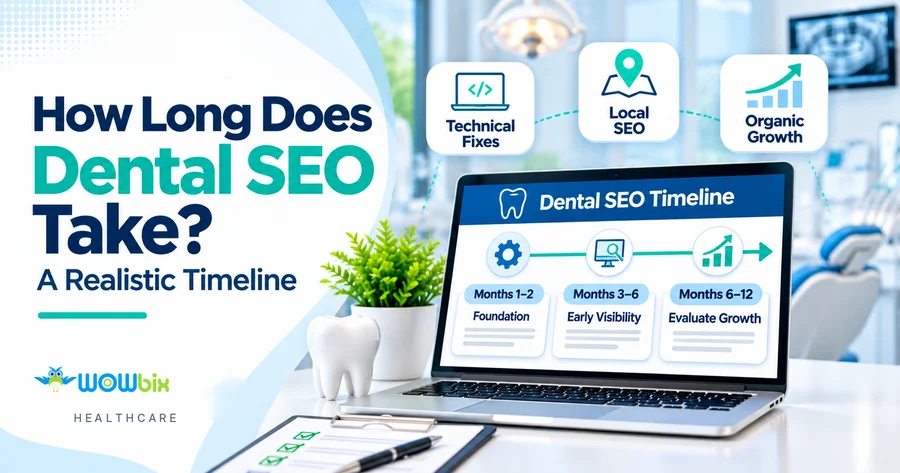
How long does dental SEO take? For many practices, early movement in search visibility may appear after about 3 to 6 months, while more substantial gains can take 6 to 12 months or longer. Those are common dental marketing practitioner estimates, not Google guarantees. A new office in a competitive city and an established practice fixing a few serious website issues may have very different timelines.
This guide explains what to expect month by month, what can slow progress, how to spot improvement before phones ring, and how to tell whether an agency is doing useful work.
How Long Does Dental SEO Take to Show Results?
The first question is what you mean by results. An indexed treatment page, a higher Google Maps position, more visitors from nonbranded searches, and a booked patient are four different outcomes. Their timing can vary. A practice may see more impressions but no new calls, or more profile interactions while its treatment pages remain hard to find.
The table separates those four clocks. Its windows are illustrative practitioner planning estimates, not a sample average, a fixed sequence or a timeline endorsed by Google.
On a phone? Scroll sideways to see all table columns.
| What changes | Illustrative first window | Where to check | What it does NOT prove |
|---|---|---|---|
| Technical fixes and indexing | Days to weeks for some fixes; longer for others | URL Inspection and indexing status | Better rankings or new patients |
| Google Maps and profile activity | Weeks to several months; no fixed schedule | Business Profile views, actions and local test locations | A call connected or appointment happened |
| Organic rankings and useful traffic | Often 3 to 6 months for early movement; some longer | Search Console queries, pages, clicks and sampled rankings | Every visitor was locally qualified |
| Qualified calls and booked patients | Frequently assessed over 6 to 12 months or more | Approved call records, forms and scheduling | That SEO alone caused all appointments |
Documented by Google: the SEO Starter Guide states that some changes may take effect in hours while others can take several months. It advises waiting a few weeks to evaluate changes. Core update guidance also says sitewide improvements can take months and never guarantees that a change will improve rankings.
The widely repeated three-to-six and six-to-twelve-month windows come mainly from agency and practitioner experience, not a named longitudinal study of U.S. dental practices. Google’s own hiring advice and podcasts discuss SEO in general, not a separately measured dental timeline. Use the ranges to plan milestones and ask better questions, not to accept a promise of first-page rankings by a certain date.
Dental SEO Month by Month: What the Work Should Look Like
Months 1 and 2: Establish the foundation
The early period should identify why relevant patients cannot easily find or contact the practice. The SEO team may audit Google Search Console, check which service and location pages are indexed, fix broken links or redirect problems, inspect mobile forms, and document the practice’s actual services and coverage area. For Google Business Profile, it may review categories, hours, office contact details and eligible locations.
An agency should produce a prioritized list of work with specific pages, owners and evidence of completion. Some issues can be fixed quickly: an unintended `noindex` directive, an incorrect office phone number or a failed appointment form. That does not establish that Google will immediately increase traffic or that the front desk will start booking more people.
Early signals may include a previously excluded treatment page becoming indexable or the correct location appearing in the Business Profile. Google Search Console may begin recording more relevant impressions. Compare the change with the site’s baseline and distinguish a technical repair from a measurable patient-acquisition result.
Months 3 and 4: Improve relevant pages and observe early signals
After critical problems are addressed, the content and local strategy should become more visible. The agency may refine an implants service page, improve a dentist biography, explain emergency appointment availability, strengthen internal links, and correct important local citations. Each page should reflect services actually provided and be reviewed for accuracy by the practice.
You might begin seeing more impressions for useful searches such as ‘family dentist [City]’ or ‘dental crowns [City].’ A less competitive page may gain clicks sooner, while a crowded market may show little movement for a high-value treatment. One ranking tracker could show improvement for a fixed location even while the practice is still rarely visible elsewhere.
A credible month-three report should show what changed, whether the changes are indexed or otherwise live, and how actual queries and pages behave in Search Console. It should not rely solely on a software health score or a collection of screenshots that cannot be reproduced.
Months 5 and 6: Look for consistency, not isolated wins
Some offices begin receiving more qualified organic inquiries during this period. Others are still building visibility, especially for competitive implant, orthodontic or cosmetic terms. Instead of judging the work from one week, compare several reporting periods with similar seasons and office operations.
Review whether relevant service pages attract more clicks, whether genuine office inquiries mention those services, and whether the front desk is answering new-patient calls. A single article moving from page three to page two is not yet a business outcome, but a broader pattern across several useful pages may show that the strategy is gaining traction.
If the agency’s monthly report still cannot name any finished improvements, show a useful query or page trend, or explain an obstacle, that is a process concern even when rankings are slow. Slow visibility is not automatic evidence of failure; months of undocumented work are a separate problem.
Months 7 to 12: Evaluate the quality of growth
For an established program, this is a reasonable period to examine the broader business impact of the work. Relevant organic sessions, Google Business Profile actions and qualified inquiries may become easier to compare against the earlier baseline. But the period is not a promise that every practice will rank in the Local Pack or produce a certain number of patients.
Look by treatment line and office. An increase in general educational traffic can be useful, but if the clinic’s priority is emergency appointments or implant consultations, examine those pages and inquiries separately. Ask whether patients can quickly find current hours, insurance information, surgeon or dentist credentials, and a working booking path.
A strong report should include the work completed, remaining technical issues, visibility trends, inquiry quality, scheduling outcomes where reliably measurable and next priorities. It should also explain setbacks such as an office move, a redesign, a competitor launching a large content project or a wider search-results change.
Year two and beyond: Maintain what works and adjust what does not
SEO is ongoing because services, staff, competing practices and search results change. Useful pages may continue receiving visits without constant rewriting, while old provider details, broken forms and outdated treatment descriptions need maintenance. A second year may be about improving the best pages, expanding into genuinely available treatments and protecting hard-won visibility.
Do not assume growth will increase automatically each month. Review priorities according to practice capacity, conversions and the local market. There is no universal SEO finish line or guaranteed cumulative return.
What Speeds Dental SEO Up or Slows It Down?
The starting position matters as much as the amount of work. A new practice has to make itself understandable to patients and Google; an established practice may already have useful pages, brand searches and legitimate reviews. A migration can bring technical risk even when the resulting website is better for patients.
On a phone? Scroll sideways to see all table columns.
| Practice situation | Why the starting point differs | What to prioritize |
|---|---|---|
| New office and new website | Little established relevant web content and local footprint | Accurate profile, indexable services, clear location and booking |
| Established office with weak SEO | May already have usable pages and known brand but overlooked problems | Repair high-value pages and known technical issues |
| Redesign or migration | New URLs, redirects, indexation and analytics can interrupt existing visibility | URL inventory, redirects, Search Console and form QA |
| Multi-location dental group | Different dentists, service menus and local competitors by office | Real office pages and location-specific reporting |
| Recovery after spam or policy problems | Corrective action and Google review may be needed | Identify actual issue; follow official guidance |
| High-competition treatment market | Many relevant practices competing for the same high-intent terms | Treatment-specific strategy and realistic capacity |
Other timing drivers include geographic competition, whether the website can be edited, existing service-page quality, real provider credentials, accurate local business information, legitimate citations and how quickly approved improvements are released. Some changes help patients directly even before Google ranks a page differently.
Review count by itself is not a stopwatch. A genuine, helpful patient review program can support trust, but forcing staff to generate a particular number of positive reviews is not a valid SEO shortcut. The practice should request honest feedback neutrally and protect patient privacy in any replies.
The practice’s own operations can slow progress. Drafts may sit awaiting approval, a clinician may need to review treatment claims, a developer may postpone a form repair, or the office may be unable to take appointments for the service being promoted. Good SEO planning names these dependencies rather than treating them as invisible agency delays.
Wowbix’s Sun Dental website rebuild and SEO foundation illustrates a redesign starting condition: the September 2026 launch addressed website structure, inaccuracies, technical setup and patient pathways. The case study had not reported postlaunch SEO or booked-patient results in the material reviewed. It is a foundation example, not evidence that SEO succeeded in six weeks.
Why Google Maps Can Move Before Organic Website Rankings
Google Business Profile and organic search results are related but not identical surfaces. A dental office can correct the profile’s address, primary category, hours, real services and appointment link while the website’s pages are still being rewritten or indexed. These practical profile changes may be visible to patients promptly, but improvements in the Local Pack are neither automatic nor guaranteed.
Google describes local ranking in terms of relevance, distance and prominence. It does not publish fixed ranking factor percentages or allow someone to buy a better organic position. Because distance and competition vary by searcher, a map ranking from one street or tool location cannot represent the entire patient market.
A monthly comparison should therefore separate the profile’s visible information and action metrics from the website’s Google Search Console clicks. The profile’s call metric counts clicks on a call button, not completed conversations. Google Business Profile Performance documents the available measures and their limitations.
An office that needs a deeper local visibility review can explore local SEO services. The main purpose here is to show why a profile update, a map-ranking change and an organic service-page result may occur on different timelines.
Signs Dental SEO Is Working Before the Phone Rings
The first signals are usually measurements of search visibility and completed work, not a guaranteed jump in new patients. Ask the SEO team to identify which changes have gone live and which relevant searches or landing pages are improving. Use the same metrics and reporting definitions each month.
Search Console: impressions, queries and service pages
In Google Search Console, open Performance, then Search results. Compare impressions and clicks for relevant queries and inspect the Pages tab. A new emergency or implant page gaining impressions for appropriate local searches may indicate that Google is showing it to more users. Filter by page, date, device or geography where the data supports that comparison.
Check which pages actually received clicks, and look at query intent rather than treating every impression equally. Search Console’s average position can help diagnose changes, but it aggregates many searches and is not a fixed local rank for every patient. Google also omits some queries for privacy, so the report does not show all searches.
Indexing: did important repairs take effect?
Use Search Console’s URL Inspection and indexing reports to verify that priority service pages can be indexed and that the canonical URL is appropriate. One accidentally excluded implants page becoming eligible for indexing is a real technical correction. It is not a promise that Google will rank the page above competing clinics or send patients to it.
When an agency says a redirect or migration issue is resolved, it should identify the original URL, the expected destination and a repeatable check. Screenshots of a perfect audit score do not replace evidence that the public page works.
Business Profile: views, directions, website clicks and call-button clicks
Open the verified Google Business Profile’s Performance section. Compare views, direction requests, website clicks and call-button clicks, considering seasonal or office changes. Google defines a call event as a click on the call button, not proof that a conversation took place. Some reported profile interactions may include ads, so ask whether the report isolates organic activity.
A profile view increase accompanied by incorrect office hours is not a marketing success. Check the information patients see as well as the activity totals. A useful measure is whether a person can quickly find the right number, office location and booking instructions.
Rank tracker: use it for context, not a universal verdict
A reputable local rank tracker can sample important treatment searches from consistent locations and dates. That can help identify geographic changes, especially for offices with several service areas. However, a grid or tracked keyword list is a snapshot under the tool’s settings. It should be used alongside first-party Search Console and Business Profile data.
Editor’s suggested month-three review: Ask for a baseline, specific completed changes, a list of remaining blockers, service-page indexing status, query and page trends, profile data, and the next month’s priorities. Even if rankings have not improved much, the agency should be able to explain what it did and how it evaluated the effect. This is an accountability suggestion, not a Google-mandated three-month checkpoint.
What if Rankings Improve but Patient Calls Do Not?
Better rankings or more website visitors are not the same as booked patients. A person may be outside the practice’s service area, researching a procedure the office does not offer, or unable to schedule within a reasonable timeframe. The website may also send a patient to the wrong office or a broken form.
Use this short diagnostic checklist with your office manager and marketing team:
Check 1. Is the office answering calls during its advertised hours, and are missed calls followed up?
Check 2. Do the phone number and appointment form work on mobile after website or tracking changes?
Check 3. Does the landing page explain the real treatment, dentist, location and consultation process?
Check 4. Can the practice offer appointments for the services attracting search interest?
Check 5. Are duplicated calls and forms being counted as one potential patient where appropriate?
Check 6. Does the report distinguish organic search, Maps actions and paid advertising rather than adding them into one lead count?
Reviewing a small sample of actual inquiry outcomes with the practice’s approved, privacy-conscious reporting can help uncover the problem. A website analytics event cannot by itself prove that a patient booked, arrived or received care. Avoid sending identifiable health information to general advertising or analytics platforms.
What the Dental Practice Can Control While SEO Develops
The agency is not the only party affecting the timeline. The practice can approve accurate descriptions of treatments, make qualified dentists available for clinical reviews, give current insurance and appointment details, and identify which services have capacity for new patients. Fast approval does not guarantee better rankings, but avoidable weeks spent waiting on a routine correction can delay the work.
Ask the front desk what patients repeatedly request, what prevents an appointment, and whether phone calls are being answered. Share the themes with the content team without copying identifiable patient histories into an ordinary marketing spreadsheet. Many useful pages begin with a practical question rather than an arbitrary high-volume keyword.
Maintain real business profiles and request authentic reviews without incentives, pressure or selective solicitation for positive ratings. A good healthcare reputation management process can keep office information and public feedback accurate, but review counts are not a guaranteed SEO countdown.
Give the SEO team access through approved account roles and keep the practice in control of its domain, Google Business Profile, Search Console, analytics and appointment data. Clarify who must approve website updates and who has the ability to publish. Avoid changing agencies merely because one weekly rank fluctuates, but do not ignore months of unverified work.
When to Worry and What to Ask the SEO Agency
A reporting deadline should be an opportunity to review evidence, not a promise that Google will react on schedule. At around three months, a practice should be able to see an audit, completed repairs, planned content or local work, functioning measurement and a clear explanation of remaining issues. If there is no record of work or no baseline, ask why.
Editor’s suggested six-month check: If the priority pages still show no relevant impressions, meaningful clicks or improvement in patient interactions, request a joint diagnosis. Compare the actual queries, page indexing, competing results, local profile eligibility and contact-path performance. A flat report is a reason to investigate, not proof that a penalty exists or that SEO will never work.
Ask the same five questions of any agency, including Wowbix:
1. Which specific pages, profiles and technical issues did you change, and how can those changes be checked?
2. Which metrics are improving for relevant services, and which are not? Can you separate organic clicks from Maps and ads?
3. How do you define a qualified inquiry and a booked patient, and what is the practice responsible for measuring?
4. Who owns the website, Search Console, Business Profile, advertising accounts, content and reporting if the engagement ends?
5. What is the current monthly scope, review cadence, contract term, cancellation process and plan if the first priorities fail?
Warning signs include guaranteed first-place rankings, claims of a special relationship with Google, a promise of a fixed number of new patients after 30 days, link schemes, content about services the practice does not offer, unexplained changes to account ownership, and reports that omit the work completed. Google’s SEO hiring guidance specifically cautions against guaranteed ranking claims and recommends asking providers to explain their work.
A legitimate agency should be willing to discuss limitations and setbacks. Technical fixes can be verified, but an organic rank or booking total remains dependent on factors outside the agency’s exclusive control. Wowbix should be held to the same standard as another provider.
Should Dentists Use Paid Ads While Waiting for SEO?
Paid search can appear once an approved campaign is launched and funded, rather than waiting for organic rankings to develop. Ads can provide a separate way to reach people actively looking for available dental services. However, an ad impression or click does not guarantee a consultation, and the practice pays for the platform’s media activity while campaigns run.
SEO and paid ads answer different questions. An office may use ads to support current appointment availability while improving treatment pages and local search fundamentals. When media spending stops, the paid delivery stops. Organic traffic is not purchased per click, but it also needs ongoing care and may change with competition or Google updates. Do not treat either channel as a guaranteed patient-acquisition machine.
Does AI Search Change the Dental SEO Timeline?
AI Overviews and conversational search systems may summarize information or show source links differently from traditional results. That can change how a patient encounters dental content or whether a website receives a click. The sources reviewed do not establish a separate, statistically supported number of months for dental practices to appear in AI answers.
A practice can still focus on factual dentist credentials, useful treatment information, accurate locations and pages that search systems can access. For a broader discussion of these emerging features, see generative engine optimization. An AI mention is a sampled appearance, not proof of a booked patient.
Frequently Asked Questions
Can dental SEO work in 30 days?
A repair can take effect within days or weeks, and some relevant visibility might appear quickly. Google’s documentation allows for fast technical effects but does not guarantee them. It is not responsible to promise a measurable increase in dental bookings within 30 days. Ask what was fixed and what evidence would count as early progress.
Does SEO take longer for a new dental practice?
Often, because a new website and local presence may have less existing relevant content, search history and independent information about the office. The exact time still depends on market competition and execution. An established clinic with a broken website can also face substantial delays.
Is it normal to see little change at month three?
It can be, particularly when the site started with serious technical or content problems. By month three, however, the practice should expect an intelligible account of completed work, current site and profile status, what has been measured and what remains blocked. No Google policy requires a ranking gain at that month.
Do I need to sign a long SEO contract?
There is no Google requirement to sign a long-term SEO contract. Providers differ in minimum terms, deliverables and cancellation conditions. Ask for a written scope, ownership and reporting rights, and what happens when the practice leaves. Choose terms based on the work and your business needs rather than a guaranteed-results pitch.
What should I check first if nothing seems to be happening?
Begin with the pages and services that matter. Verify important pages are indexed in Search Console, review their impressions and clicks, confirm the correct Google Business Profile information, and test calls and appointment forms. Then ask the agency what it actually changed, how it checked the work and what next step the evidence supports.
Conclusion: Judge Dental SEO by More Than a Calendar
For many dental practices, 3 to 6 months is a useful window to look for early visibility and 6 to 12 months is a common planning window for more substantial results. These are practitioner estimates, not guarantees. The three most useful habits are separating search metrics from bookings, fixing patient contact problems quickly and asking for an accountable monthly report.
Wowbix provides dental SEO services and publishes this guide, but the same evidence standards should apply to its work as to any agency. If a practice wants to discuss current SEO problems or a realistic work plan, contact Wowbix for a scope conversation. No ranking, timing or new-patient outcome is promised.