
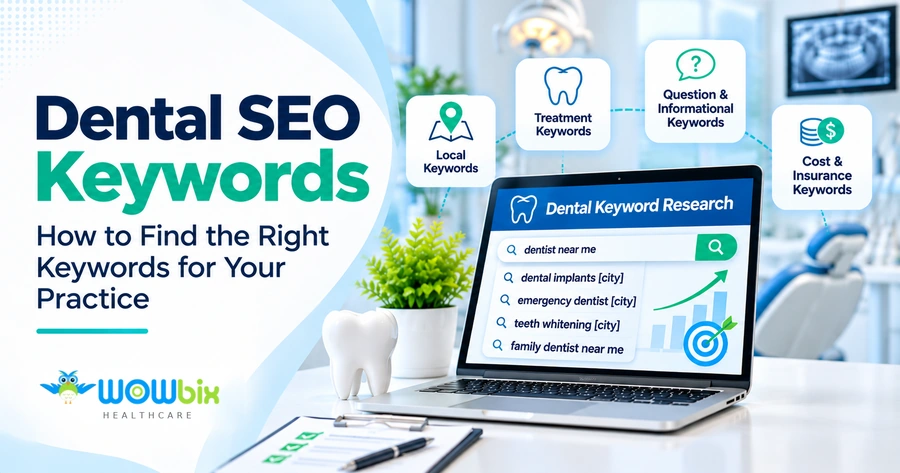
A dental website can attract plenty of search visitors without attracting the patients your office wants to see. An article about tooth anatomy might reach readers nationwide, while someone searching for an emergency dentist in your city may be ready to call a nearby practice.
The difference starts with choosing the right dental SEO keywords. Focus on the treatments your office actually provides, the places patients can reasonably travel from, and the questions they need answered before booking. Then match those searches with useful pages instead of repeating every keyword across your website.
What Are Dental SEO Keywords?
Dental SEO keywords are the words and questions people type into Google when looking for dental care, a practice, or information about a treatment. A keyword tells you something about a person’s need, but the search results help reveal whether that person expects a local provider, a price explanation, a comparison, or a how-to answer.
Compare ‘what are dental implants?’ with ‘dental implant dentist in [City].’ The first often suggests learning about a treatment. The second more directly suggests comparing nearby providers. A dental implant service page can explain the treatment and offer a consultation; a separate educational article may answer detailed questions and lead interested readers to that page.
No keyword automatically guarantees an appointment. A useful keyword becomes valuable when the practice offers the service, the searcher is in its real market, the page satisfies the question, and the person has a working way to contact the office.
What Are the Best Dental SEO Keywords?
There is no best list for every dentist. A general family practice, an orthodontic office, and a specialist treating gum disease need different terms. Even two offices offering the same services can have different priorities because their locations, appointment capacity, competition and existing visibility differ.
Start with service-and-location terms for treatments the practice wants to promote, then add relevant cost, insurance, comparison and patient-question topics. Check the actual search results before assigning a page type. The following examples are illustrative, not verified national or local keyword-volume data.
On a phone? Scroll sideways to see all table columns.
| Keyword category | Example searches | Likely intent | Recommended destination |
|---|---|---|---|
| General local | dentist in [City]; dentist near me; dental office [Neighborhood] | Find nearby practice | Homepage or real location page |
| Family dentistry | family dentist [City]; family dental care near me | Compare family practices | Family dentistry service or homepage |
| Emergency | emergency dentist [City]; urgent dental care [City]; broken tooth dentist near me | Seek urgent care | Emergency dentistry service page |
| Implants | dental implants [City]; implant dentist near me; tooth replacement options | Find treatment or compare options | Implants page plus options guide |
| Cosmetic | cosmetic dentist [City]; teeth whitening [City]; dental veneers near me | Explore cosmetic services | Relevant cosmetic treatment pages |
| Orthodontic | orthodontist [City]; braces near me; clear aligners [City] | Find orthodontic care | Orthodontic or aligner service page |
| Pediatric | pediatric dentist near me; kids dentist [City]; children’s dental care | Find care for child | Pediatric dentistry page |
| Cost and payment | dental implant cost [City]; dentist accepting [Insurance]; dental financing [City] | Compare affordability | Service cost, insurance or financing section |
| Comparison | dental crown vs veneer; Invisalign vs braces; dentures vs implants | Understand options | Comparison guide or relevant treatment FAQ |
| Informational | how long do dental implants last; is teeth whitening painful; dental cleaning frequency | Learn about care | Clinician-reviewed article or FAQ |
| Branded | [Practice Name] dentist; [Dentist Name] reviews; [Practice Name] hours | Find known practice | Homepage, provider profile, contact page |
Some categories overlap. ‘Emergency dentist open Saturday [City]’ is local, urgent, long-tail and potentially commercial. Treat it as one search need, not four separate pages.
Types of Dental SEO Keywords You Should Understand
Local keywords connect care with a real place
Patients might search ‘dentist near me,’ ‘family dentist in [City]’ or ‘children’s dentist [Neighborhood].’ These are local searches even when the person does not type a city, because Google may use location context. The practice website and Google Business Profile should clearly represent real office addresses and services. Learn more in Wowbix’s local SEO for dentists guide.
Do not publish nearly identical pages for every suburb on the map. Use useful pages for genuine locations and, where there is distinct patient value, relevant service-area information. A made-up address or misleading ‘near me’ wording does not make a business closer to patients.
Treatment keywords identify the care someone seeks
Examples include ‘dental implants [City],’ ‘teeth whitening dentist,’ ‘root canal treatment near me,’ ‘same-day dental crowns [City]’ and ‘gum grafting dentist.’ These can support service pages when the practice actually offers the treatments. Patient language and clinical terms can belong together, but check clinical distinctions: a tooth extraction is not the same procedure as root canal therapy, and clear aligners are not automatically Invisalign treatment.
Long-tail keywords describe a more specific need
A long-tail search is more detailed, such as ‘dentist who accepts [Insurance] in [City]’ or ’emergency dentist open on Sunday near me.’ Longer phrases can clarify what patients need, but they are not automatically easier to rank for or more likely to book. Verify actual local demand and availability instead of assuming every detailed phrase deserves a page.
Informational keywords answer patient questions
Patients may ask ‘how long do dental implants last,’ ‘crown versus veneer,’ ‘is teeth whitening painful,’ or ‘how often should I get a dental cleaning.’ Use accurate, clinician-reviewed pages or articles that answer the question without implying every reader is ready to book. Link relevant educational topics to a service page only when the connection helps the reader.
Cost, financing and insurance keywords help patients compare
Searches such as ‘dental implant cost [City],’ ‘does insurance cover a root canal,’ and ‘dentist accepting [Insurance]’ may signal financial or provider-selection needs. A useful page should clearly explain which insurance plans the practice actually accepts, whether quotes require an examination and which financing options exist. Do not publish invented prices or promises of coverage.
Emergency keywords signal urgency, not guaranteed availability
Searches such as ’emergency dentist [City],’ ‘broken tooth dentist near me’ and ‘toothache emergency dentist’ call for accurate hours, phone access and treatment information. Do not optimize for ‘open 24 hours’ or ‘same day’ unless those claims are consistently true. See how this differs from planned care in Wowbix’s emergency dentist SEO page.
Branded and navigational terms help protect practice discovery
A practice’s name, dentist names and accurate location details may be searched by existing patients, referrals and people checking reviews. Track those searches separately from nonbranded treatment demand. Strong brand searches can improve total organic traffic without demonstrating that an SEO program brought new patients who had never heard of you.
Dental SEO Keywords by Service and Specialty
Your target phrases should reflect your license, clinical qualifications and the care actually available at each office. Patients searching for pediatric care may want a children’s dentist close to home; implant patients may compare cost and provider experience; someone with an urgent problem may care most about today’s hours and the next step. These are useful differences in likely intent, not guaranteed conversion rates.
The table combines example search phrases and suggested content. The examples need local SERP and keyword-tool validation before they become a practice’s target list.
On a phone? Scroll sideways to see all table columns.
| Service or specialty | Example keywords | Search goal | Suggested page |
|---|---|---|---|
| General dentistry | general dentist [City]; dental cleaning near me; dental exam [City] | Routine treatment and office selection | General or preventive service page |
| Cosmetic dentistry | cosmetic dentist [City]; veneers [City]; professional teeth whitening | Cosmetic consultation | Cosmetic and individual treatment pages |
| Dental implants | implant dentist [City]; missing tooth replacement; dental implants cost | Provider and options research | Implant treatment page and cost FAQ |
| Emergency dentistry | emergency dentist near me; broken tooth dentist; urgent tooth pain care | Timely contact | Emergency service page with accurate hours |
| Pediatric dentistry | pediatric dentist [City]; children’s dentist near me; first dental visit | Find child-focused care | Pediatric service page |
| Orthodontics | orthodontist [City]; braces near me; clear aligner provider | Compare alignment providers | Orthodontics or treatment page |
| Oral surgery | oral surgeon [City]; wisdom tooth removal near me; tooth extraction specialist | Find qualified surgical care | Relevant surgical treatment page |
| Periodontics | periodontist [City]; gum disease treatment; gum graft specialist | Identify gum-care specialist | Periodontal treatment page |
| Restorative dentistry | dental crowns [City]; dentures near me; root canal [City] | Find restorative treatment | Separate genuine treatment pages |
Do not treat every specialty as a separate business line if it is not offered. For example, a practice that places implants may have different services and credentials from an oral surgery center, and a general family dentist should not claim to be a pediatric specialist unless the designation is accurate.
How to Find SEO Keywords for Your Dental Practice
Step 1: List the treatments you actually want patients to find
Write down the services currently provided at each location and the appointments you have capacity to book. Include general care, preventive visits, urgent care and selected elective treatments where relevant. Ask the dentists and front desk what patients call these procedures. ‘Tooth replacement’ and ‘dental implants’ are related searches, but the best page must explain the actual options the practice offers.
Step 2: Add the locations patients can reasonably visit
Pair the important services with your office city, real neighborhood names and nearby places that send patients to the practice. Don’t assume residents of every surrounding city travel the same distance or prefer the same office. For a multi-location practice, assign keywords and appointment paths to the office that actually provides the treatment.
Example starting phrases for a practice offering those services might be ‘family dentist [City],’ ‘dental implants [City],’ ’emergency dentist [City]’ and ‘pediatric dentist [Neighborhood].’ A list is only a starting hypothesis. The local search results tell you whether Google is showing Maps listings, individual office pages, treatment guides or directories.
Step 3: Review your existing Google Search Console queries
If the website has a verified Search Console property, go to Performance → Search results and select Queries. Compare clicks, impressions and click-through rate for relevant treatment searches. Select a query and look at the Pages tab to see which URL has appeared for it. Then filter for U.S. searches and the relevant device or pages when helpful.
A phrase with many impressions but few clicks may point to a weak title, the wrong landing page or a result that doesn’t meet the searcher’s need. It can also reflect the layout of the results or intent to stay in Maps. Review the actual results before making changes. Search Console hides some queries for privacy and does not report all market-wide opportunities, so it should not be your only research source.
Step 4: Use Keyword Planner with the right location settings
In Google Ads Keyword Planner, choose Discover new keywords, enter the relevant treatments and set geographic targeting around the practice’s patient market. Review suggested phrases and the average monthly search estimates. The figures reflect advertising-oriented data for your selected settings; the competition column describes advertisers, not how hard it is to rank organically.
If the city is very small, the tool may combine close variants or provide limited data. That doesn’t prove a phrase is worthless. Check the related terms, actual search results, nearby-area data and whether the topic matches real patient demand. Do not calculate expected organic patients directly from Keyword Planner ad forecasts.
Step 5: Inspect local competitors without copying their websites
Search several priority phrases from a relevant geographic context. Note whether the results are dominated by the local Map Pack, an individual treatment page, an educational article or a broad directory. Visit comparable practices and check how they describe services, office details, costs and booking. Record content gaps you can fill accurately, such as a better explanation of emergency availability or a useful comparison of treatment options.
Do not make a new page solely because a competing dentist has one. First ask whether your practice offers the same service and whether patients need a distinct answer.
Step 6: Use real patient questions and seasonal context
Ask the front desk what patients repeatedly ask about coverage, treatment timing, sedation, tooth replacement, cosmetic options and recovery. Consider whether those questions deserve a short FAQ on the relevant service page or a more detailed, clinician-reviewed article. Google Trends may help compare relative changes in interest, but its indexed values are normalized and are not monthly search counts.
Step 7: Group phrases into a manageable set of page topics
Put phrases together when they express the same need. ‘Dental implant dentist [City],’ ‘tooth implants [City]’ and ‘dental implants near me’ may often belong to a core implant service page, subject to reviewing search results. The separate question ‘how long do dental implants last’ may deserve its own educational explanation or a substantial section on that page.
Your deliverable should be a keyword map, not hundreds of disconnected lines in a spreadsheet. Each group should show primary intent, related phrases, existing or proposed page, responsible owner and a practical next action.
How to Choose Which Dental Keywords to Target First
Prioritize in this order: Does the practice genuinely offer the service? Does the search match a real location and patient need? Is the searcher looking for a provider, learning, or comparing? Does a useful page already exist? Is there enough evidence of demand to justify the effort? What will it take to create or improve that page?
A high-volume national keyword might attract students, people outside the service area or patients seeking care the practice does not provide. A smaller local search about an available service can be more actionable. Your team can use High, Medium and Lower as planning labels, but they are not Google-issued difficulty grades.
On a phone? Scroll sideways to see all table columns.
| Illustrative keyword group | Business relevance | Search intent | Existing page | Suggested priority |
|---|---|---|---|---|
| emergency dentist [City] | High if emergency appointments are available | Urgent provider search | Existing emergency dentistry page | High |
| dental implants [City] | High if implants are provided and capacity exists | Treatment provider comparison | Existing implants page | High |
| dentist accepting [Insurance] [City] | High only if that plan is accepted | Insurance-qualified provider search | Insurance or location page | High |
| dental cleaning near me | Depends on hygiene capacity | Local routine care | Preventive service page | Medium |
| dental crown vs veneer | Relevant for practices offering both treatments | Treatment comparison | Informational guide, if absent | Medium |
| how often should I floss | Broad educational topic | Information, often outside local market | Educational content only if helpful | Lower |
Start with the High priorities that already match real services and have a clear next step. Validate every example against the practice’s market and availability. For an established site, consider improving an existing relevant page before commissioning new content.
How to Map Dental SEO Keywords to the Right Website Pages
A keyword map assigns each group of related searches to the page best able to satisfy its intent. Homepage and genuine location pages usually support practice-finding searches. Treatment pages explain available care and encourage appropriate inquiries. Articles answer narrower informational or comparison questions. Cost and insurance sections belong where they can provide accurate answers.
On a phone? Scroll sideways to see all table columns.
| Main keyword group | Related phrases | Likely intent | Recommended main page |
|---|---|---|---|
| dentist in [City] | dental office [City]; dentist near me | Find a nearby practice | Homepage or genuine location page |
| family dentist [City] | family dental care; general dentist [City] | Find suitable family practice | Family dentistry or office page |
| dental implants [City] | implant dentist; tooth implants [City] | Find an implant provider | Implant service page |
| emergency dentist [City] | urgent dental care; emergency tooth appointment | Seek urgent provider | Emergency dentistry page |
| pediatric dentist [City] | kids dentist; child dental care [City] | Find children’s dentist | Pediatric service page |
| dental crown vs veneer | crown or veneer; veneers vs crowns | Compare care options | Treatment comparison article |
| dental implant cost [City] | implant financing; what implants cost | Research treatment price | Implant page cost section or cost guide |
| how long do dental implants last | implant longevity; dental implant lifespan | Treatment education | Clinician-reviewed informational guide |
The point is not to assign one exact phrase to one URL forever. Google understands related wording, and users search in different ways. Several phrases can share a page when the intent is genuinely the same. Conversely, an article about implant recovery and a local implants service page may both mention implants without competing for the same search need.
If a single city has three near-identical implant pages, check whether each serves a different patient question. If they do not, consolidate the content thoughtfully and evaluate any redirects, existing organic visibility and internal links. Do not mass-delete pages based on keyword overlap alone.
Common Dental Keyword Mistakes to Avoid
Choosing only the highest-volume terms: Start with relevance to patients who can visit the practice. Volume should inform the decision, not make it.
Targeting treatments you don’t provide: Search traffic is not useful when the clinic cannot deliver the advertised care, and misleading claims can damage trust.
Publishing a page for every spelling variation: ‘Implants dentist’ and ‘dental implant dentist’ usually do not need thin duplicate service pages. Compare search intent and build one helpful resource where appropriate.
Repeating city names and ‘near me’ unnaturally: Use your real address, office details and natural explanations. Keyword stuffing is not a local SEO strategy.
Ignoring the intended patient: A guide about ‘why do gums bleed’ and a page for ‘periodontist near me’ may serve different stages of the patient’s decision. Provide the right answer for each.
Ignoring existing pages: Before writing a new guide, find out whether the site already answers the same question. Improving the existing URL can preserve useful content and reduce duplicate work.
Measuring success only by rank: Being visible for a term that never produces qualified inquiries is different from helping nearby patients contact and book with the office.
How to Track Dental Keyword Performance
Use Search Console to see which queries and pages earn impressions and clicks. Use GA4, if installed correctly, to review organic visitors and the contact actions measured on the website. Business Profile performance can help describe interactions with the local listing, but those interactions should not automatically be counted as new patients.
Separate four stages in reporting: search visibility, website or profile interactions, qualified inquiries, and confirmed appointments. A tap on a telephone link is not proof that a phone call is connected. One person who calls twice and submits a form is not necessarily three separate prospects. A form submission may be a request, not a booked appointment.
For example, if an implant page begins receiving more local impressions, check whether its organic visitors also produce genuine consultation inquiries, whether the front desk follows up, and whether the office records bookings. Do not attribute a booked patient to a specific organic keyword if the available tracking only reliably identifies the landing page or broader channel.
Handle patient information carefully. Avoid sending identifying health details into general analytics events. Any call, CRM or form integrations should be reviewed for appropriate privacy and vendor obligations.
When to Ask for Professional Dental Keyword Research
Professional help can be useful when the practice has several locations, treatment pages targeting the wrong searches, overlapping content, a complex site migration or reports that cannot be tied to patient inquiries. A qualified provider should deliver a documented set of opportunities, local intent review, keyword clusters, existing-page mapping, gap recommendations, priorities and a measurement plan.
Ask to see how priorities were chosen, which services and locations were excluded and what work each page needs. A long keyword spreadsheet is not sufficient if the practice cannot tell what should be updated first. For broader implementation after research, Wowbix’s dental SEO strategies guide explains complementary work.
Choose Dental Keywords That Match the Patients You Serve
The strongest dental keyword plan is not the one with the most search phrases. It is the one that connects real treatments, actual locations, useful website pages and reliable appointment follow-up. Begin with the services you want to promote, validate how people search in your market, then improve or create the pages that answer those needs.
If your team is unsure which searches and pages deserve priority, discuss a practice-specific keyword and SEO review with Wowbix Healthcare. The plan should reflect your practice’s treatments, location, existing visibility and capacity to serve new patients.
Dental SEO Keyword FAQs
What are the best SEO keywords for dentists?
The most useful phrases match the practice’s real services and local market. Service-and-location searches often deserve early attention, alongside accurate cost, insurance and patient-education topics. Verify demand and the results in your specific market.
How many SEO keywords should a dental website target?
There is no required number. Start with a manageable group for each important service or real location, map related phrases by intent, and build useful pages. A clear page plan matters more than a long list.
Are local dental keywords better than broad keywords?
Local phrases are often more relevant to choosing a nearby provider. Broad informational searches can still help patients understand treatments. Use each category for the need it serves and measure qualified inquiries rather than assuming one type always wins.
How do I find low-competition dental keywords?
Look for specific real services and underserved patient questions in your service area, then inspect the actual local results. Keyword tool difficulty scores can provide context, but they do not promise easy rankings or bookings.
What are long-tail keywords for dentists?
They are more specific phrases, such as ‘dentist accepting [Insurance] near [Neighborhood]’ or ’emergency dentist open Sunday [City].’ Use them where they match true services, hours and patient needs.
How often should practices revisit their keyword map?
Review it when services, dentists, practice locations or patient capacity change and during a regular reporting cycle. Recheck search queries and page performance after meaningful website updates. There is no fixed Google requirement to rewrite keyword maps every month.