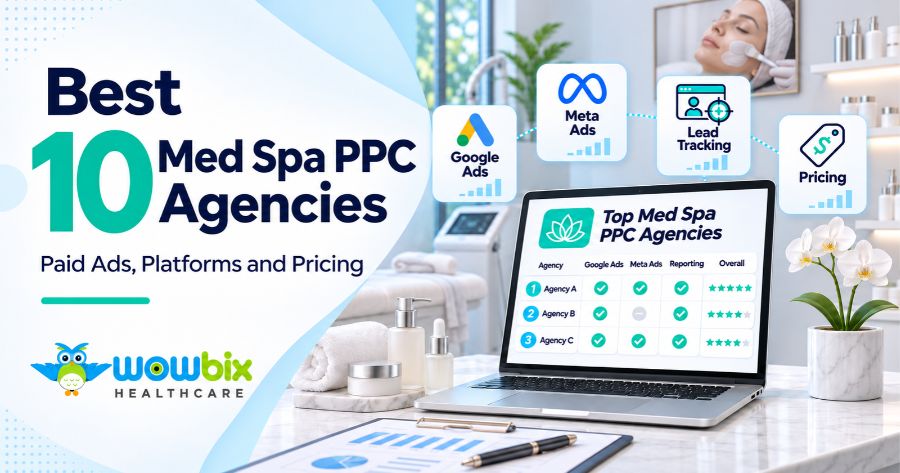
Choosing among the best med spa PPC agencies is difficult when one provider quotes a management fee, another quotes a minimum advertising budget, and a third shows lead results without explaining how many appointments were booked. A medical spa needs more than clicks. It needs campaigns that reach appropriate patients, respect advertising rules, and send qualified inquiries to a scheduling process that actually works.
This comparison looks at ten agencies with published medical spa paid advertising information. Each receives the same questions: Which platforms does it name? Does it publish management prices, contract terms, account ownership arrangements, med spa paid results or a privacy approach? A missing answer is marked as missing from the reviewed page, not as proof that the agency does not offer it.
The agency details below reflect pages examined for the November 2026 research review. Advertising services, prices and contracts change. Ask for current documentation before making a decision. PPC here covers paid search and related paid advertising management, including paid social where a provider lists it. Advertising spend paid to Google or Meta is distinct from an agency’s management fee.
For a comparison of organic search vendors instead, see the separate med spa SEO agencies guide. This article stays focused on paid campaigns, management and measurable consultation outcomes.
How This List Was Built
What was reviewed
The comparison uses each provider’s own medical spa PPC or relevant med spa paid advertising page. The evidence fields are identical for every company: named advertising platforms; published fee and billing unit; contract term and cancellation notice; ad account ownership; med spa paid advertising case evidence; and the published privacy or tracking approach.
A page describing Google Ads management gives better evidence for a Google Ads offering than a general agency directory profile. A published client story is useful, but an agency’s self-reported figures are not equivalent to audited results. A case about search optimization, website traffic or a different healthcare specialty cannot automatically establish medical spa PPC outcomes.
Each agency profile includes a direct source link. Any ‘not stated’ entry refers only to the specific source page reviewed. It is an invitation to ask the provider for details, not an accusation that it lacks the capability. A more recent quote, case study or signed service schedule could provide information missing from its public page.
How the order was chosen
Wowbix is first because it publishes this guide and chose to feature itself. That interest is disclosed rather than presented as an independent award. The other nine agencies follow a research-based editorial sequence that favors the amount of verifiable detail published for med spa PPC, including pricing, account control, campaign channels and evidence. This is not a scoring system or measurement of comparative campaign effectiveness.
There is no claim that a provider listed second performs better than one listed seventh. Some organizations need Google Search expertise, others need a mix of Meta advertising and creative production, and larger groups may need location-specific reporting or integrations. A practical shortlist depends on the practice’s actual treatment mix, locations, internal capacity and budget.
What the list does not establish
No private advertising account was audited, no client reference was interviewed, and campaign results were not independently verified across agencies. The research did not establish statistically representative med spa cost-per-click benchmarks, a valid national fee average or customer satisfaction rankings. Differences between publicly visible case studies may reflect budgets, timing, location, services or attribution methods rather than agency skill alone.
Use this guide to narrow candidates, then send the same practice brief to two or three finalists. Ask for current proposals, real campaign examples from similar services, sample reports and written account-access terms. A credible answer can be more valuable than a prominent position in a published shortlist.
Med Spa PPC Agencies Compared at a Glance
On a phone? Scroll sideways to see all table columns.
| Agency | Platforms named | Published PPC management price | Minimum term | Account ownership stated | Med spa paid results |
|---|---|---|---|---|---|
| Wowbix Healthcare | Not stated | Not stated | Not stated | Not stated | No med spa PPC case shown |
| Redefine Web | Google Search, Meta, YouTube, TikTok, PMax, other formats | $999, $1,499, $2,499/month; media separate | 6-month standard term; enterprise terms differ | Client owns accounts, pixels and creative | Self-reported med spa lead/consult results |
| ThinkProfits | Google Search, Meta, PMax, TikTok, YouTube | Fee not stated; says no ad-spend markup | Month-to-month | Practice owns ad account and payment method | No named med spa paid case shown |
| NKP Medical | Not clearly stated | Not stated | Not stated | States client owns accounts and landing pages | Arizona med spa lead lift, self-reported |
| SagaPixel | Google Ads, Meta | Not stated | No long-term agreement stated | Not stated | Meta Botox campaign $17/lead, self-reported |
| Web Tonic | Not clearly stated | Custom on service page; $3,000/month on own list | Not stated | Says client owns ad accounts and tracking | No named med spa case shown |
| Brenton Way | Not clearly stated | Not stated; inquiry budget categories are not fees | Not stated | Not stated | SY Aesthetics results, agency-reported |
| Thrive | Google Ads, Bing Ads | Not stated | Not stated | Not stated | No named med spa PPC case shown |
| Best PPC Firm | Not clearly stated | Not stated | Not stated | Not stated | Unnamed med spa lead growth, self-reported |
| Emulent | Google Ads Search and PMax | Not stated | Not stated | Not stated | No named med spa result shown |
Source basis: the agencies’ own service pages reviewed in November 2026. ‘Not stated’ means the information was not available on the reviewed page, not that the company does not provide it. Advertising spend is separate from management charges unless the provider explicitly says otherwise.
The 10 Med Spa PPC Agencies to Compare in 2026
1. Wowbix Healthcare
Wowbix is a digital marketing agency based in Paramus, New Jersey, with a healthcare division offering paid advertising and other digital services for healthcare practices. It appears first because this is a Wowbix-published article, not because an independent evaluation established it as the highest-performing med spa PPC agency.
The company’s Healthcare PPC service page describes PPC auditing and optimization, targeted campaigns, ad copy and creative, landing page optimization, local paid advertising strategies, and campaign tracking and reporting. Its separate medical spa marketing page includes medical spa advertising among wider services. These are descriptions of offered work, not measured campaign results.
Wowbix’s med spa marketing content names Bergen Aesthetics, Seeker Dermatology and Mind Your Skin Dermatology Plastic Surgery as examples of related aesthetic or medical marketing work. The publicly described services involve web design, SEO or broader marketing. They should not be represented as med spa PPC case studies or evidence of a specific paid advertising return.
Platforms named for med spa PPC: Not stated on the reviewed Healthcare PPC page. Management price: Not stated. Contract minimum and termination notice: Not stated. Account and creative ownership terms: Not stated. Verified med spa paid advertising results: Not published on the pages reviewed. Tracking/privacy arrangements or a business associate agreement for PPC: Not stated on the pages reviewed.
That information gap matters because an agency can describe ad management broadly without telling a practice how campaigns will be billed or who controls the accounts after the relationship ends. Wowbix should be asked for the same documentation as every other company: proposed platform mix, monthly management fee, advertising budget, onboarding work, qualified inquiry definitions, reporting sample, account-access rights and privacy-sensitive data flows.
Best suited to: A practice seeking to discuss paid advertising alongside website, local visibility or broader healthcare marketing work, provided the proposed PPC scope and evidence match its needs. A buyer comparing only specialized med spa PPC may want a documented paid campaign example before proceeding. Current scope and pricing should come from an individual quote rather than SEO pricing published elsewhere on the site.
2. Redefine Web
Redefine Web publishes one of the more detailed med spa PPC service descriptions in the reviewed set. Its med spa PPC page lists Google Search, Performance Max, YouTube, Meta, TikTok, display advertising and other formats. These channels are not automatically appropriate for every treatment or advertiser. A practice should ask which platforms it would actually use and why.
The page advertises flat monthly management tiers: Launch at $999 for up to $2,000 in advertising spend, Growth at $1,499 for up to $5,000, and Scale at $2,499 for up to $10,000, plus a custom enterprise tier. The company says advertising money is billed separately rather than taken from those management fees. These are published vendor offers observed in November 2026, not a standardized market price.
The researched page describes a six-month initial term for its standard tiers, a longer enterprise arrangement, ownership of ad accounts and creative by the client, and an account handoff process. Its contract details and any exceptions should be verified in the current proposal. These are useful questions because agency ownership of an advertising account can affect continuity when a med spa changes vendors.
Redefine Web publishes med spa campaign stories, including consultation-request growth and lower costs per lead. Those are the agency’s own reported results; the reviewed examples did not expose complete baseline data needed to compare them independently with other practices. The page also describes tracking approaches but does not establish a universal HIPAA compliance conclusion for every customer’s website.
Best suited to: Practices seeking a published tier-based management framework, broad channel options and written discussion of handoff rights. Ask how the agency qualifies bookings and how the quoted tier changes if media spend or the number of locations grows. Source: Redefine Web med spa PPC.
3. ThinkProfits
ThinkProfits describes paid advertising management specifically for medical spas on its PPC for med spa page. It lists Google Search and several additional campaign formats, including Meta advertising, call-focused ads and video or automated Google campaigns. The range of channels suggests flexibility, but the practice still needs a written plan for which services and audience segments each campaign targets.
Its public page describes a month-to-month arrangement and says media spend is paid through the practice’s own advertising accounts and payment method. It also describes no markup on advertising spend. That does not establish the separate management fee, which was not stated on the page reviewed. Ask for the monthly retainer, setup fee, minimum spend, any creative production charges and how cancellation works.
ThinkProfits discusses tracking practices, including avoiding protected health information in URLs and using privacy-related controls. Those are described practices, not proof that any customer’s whole system meets every healthcare privacy obligation. A medical spa should still have its actual forms, analytics events and vendor flows reviewed by an appropriate privacy professional.
The reviewed page did not identify a named med spa paid advertising result that could be independently compared with the other agencies. It uses performance-oriented language and cost discussions, but a buyer should request actual case data from a practice with a similar treatment offering and geography, including the starting period and booked consultation definition.
Best suited to: Owners who prioritize monthly contract flexibility and direct control of platform billing, subject to reviewing the complete scope. Ask who has administrative access to conversion tracking and whether the practice retains campaign history when the agreement ends. Source: ThinkProfits medical spa PPC.
4. NKP Medical
NKP Medical is a medical marketing agency with a published med spa PPC-related service page and a broader focus on aesthetic and physician practices. The reviewed material discusses paid campaigns for a medical spa and the goal of increasing patient inquiries. Its public med spa PPC material provides more direct specialty context than a general-purpose PPC page.
The research brief identifies one Arizona multiservice med spa case in which NKP reports a 125% increase in leads. That is a self-reported outcome, and the public description did not provide a complete starting baseline or independently auditable appointment totals. Lead growth is useful evidence of campaign activity, but a dentist or med spa owner should not treat it as a guaranteed increase in completed appointments.
The reviewed page did not state a med spa PPC management fee, an initial contract duration, a complete named channel list or a specific privacy and business associate agreement process. It describes account or landing-page ownership in client-friendly terms, which merits confirmation in a contract. Request exact administrator rights and a written handoff inventory, not just a general ownership statement.
Best suited to: A practice evaluating an agency with aesthetic-market experience and publicly described lead generation work. Ask the company to distinguish paid results from organic or other channels, show qualified lead criteria, and explain whether ads target local visits, consultations or specific services. Source: NKP Medical med spa PPC information.
5. SagaPixel
SagaPixel’s med spa PPC page describes Google Ads and Meta advertising for aesthetic practices. The company also publishes SEO case material for the category. When evaluating this provider, separate the paid campaign evidence from organic search results because higher website traffic or SEO visibility does not automatically establish better PPC performance.
The reviewed page reports a $17 cost per lead on a Meta campaign for Botox-related med spa advertising. That is SagaPixel’s own campaign result, not a general cost-per-lead benchmark. It is also a lead figure rather than a verified cost per booked or attended consultation. A prospective client should ask for the campaign dates, geographic market, creative restrictions, paid budget and evidence connecting inquiries to appointment records.
SagaPixel describes not requiring long-term agreements. The source page did not provide a verified management fee, full cancellation schedule, transfer procedure or med spa-specific privacy documentation. A third-party list cited a percentage-of-spend pricing range, but that has not been adopted here as a confirmed company fee.
Best suited to: Practices seeking a provider that publicly discusses both paid search and paid social for aesthetic treatments, particularly where a direct lead-generation example is helpful. Ask for a written campaign scope and how changes in treatment advertising policy would be handled. Source: SagaPixel med spa PPC.
6. Web Tonic
Web Tonic has a dedicated medical spa PPC services page and publishes broader lists of agencies and med spa advertising statistics. Its public material discusses planning and managing paid campaigns for aesthetic practices. The provider’s own listicle includes a published $3,000 monthly figure for Web Tonic, while the specific service profile describes pricing as custom. Because those presentations are not identical, this comparison does not treat $3,000 as a confirmed starting retainer.
The PPC service page discusses account setup and campaign management, and says ad accounts, landing pages and tracking assets remain in the client’s name. That is a potentially valuable ownership feature. Confirm who holds administrator access, whether pixels and conversion integrations are also transferable and how files are delivered if the agency relationship ends.
The reviewed med spa PPC page did not clearly identify every platform used, a minimum contract term, or a named med spa paid campaign with auditable bookings. Its general case studies should not be substituted for a specific medical spa PPC result. The page also uses broad language about handling health-related information appropriately without explaining the data flows or agreements applicable to an individual practice.
Best suited to: Med spas considering an agency that explicitly markets itself to the category and discusses client ownership of campaign assets. Ask for a service-specific quotation, exactly what is included, and one case with qualified lead and attended consultation reporting. A fee on an agency-authored list is not equivalent to a binding proposal. Source: Web Tonic med spa PPC.
7. Brenton Way
Brenton Way’s med spa PPC agency page focuses on advertising for aesthetic and related healthcare businesses. Its materials discuss acquisition, campaign improvement and the connection between advertising and treatment revenue. A medical spa considering the company should ask which services are included in the proposed PPC work versus other marketing functions it may also offer.
The page highlights work with SY Aesthetics and reports a multiple of marketing-attributed revenue and a number of surgical cases. Those figures are agency-reported and need careful interpretation. Surgical cases are not necessarily med spa consultations, and an attributed revenue calculation depends on the agency’s measurement model, time period, source data and baseline. They should not be treated as verified likely outcomes for a different practice.
The reviewed page did not publish a definitive PPC management fee or standard contract term. Its lead form asks about budgets beginning at a substantial monthly level, but a form’s budget categories are not the agency’s minimum management rate. The source also did not set out a concrete med spa tracking privacy or business associate agreement process, or a complete statement of advertising account ownership.
Best suited to: Clinics seeking a conversation about paid media and broader acquisition planning for high-value aesthetic services, provided the actual treatment type and budget fit are confirmed. Request a written breakdown of management, platform spend and creative work. Ask how reported cases are connected with bookings and attendance rather than merely lead submissions. Source: Brenton Way med spa PPC.
8. Thrive Internet Marketing Agency
Thrive publishes a dedicated medical spa PPC agency page discussing Google Ads and Bing Ads management for medical spas. Its broader digital marketing offering may include other services, but the evidence used here concerns the paid search page. A practice should distinguish services described across the entire website from those actually included in its proposed PPC engagement.
Thrive describes campaign planning and optimization for paid search. The reviewed page did not contain a named med spa PPC case study with measurable consultation outcomes, a clear agency management price or a defined minimum term and notice period. A wide budget selector in an inquiry form does not establish what the company charges. The page did not provide a specific medical spa patient-data tracking or HIPAA implementation procedure.
A practice evaluating Thrive should ask which treatment campaigns and landing pages would be developed, whether call reporting and qualified inquiry review are provided, and which system would contain appointment outcomes. A sample monthly report should show how paid media decisions affect qualified contacts, not just how many ad impressions were delivered.
Best suited to: Med spas that want a provider with published paid search expertise and may also require related website or marketing support. The buyer should request a treatment-specific scope, a current quote, administrative access terms and evidence from comparable aesthetic accounts. Source: Thrive medical spa PPC.
9. Best PPC Firm
Best PPC Firm maintains a PPC for med spas page and describes advertising management intended to generate inquiries for aesthetic services. Its public messaging refers to a money-back offer and publishes a percentage increase in leads for an unnamed med spa. That number is a vendor-reported example, not an independently verified improvement in booked appointments.
The company needs to be asked for the complete terms of any guarantee or refund, including eligibility, exclusions, the performance period, obligations of the practice and whether platform advertising payments are excluded. A sales statement about money back does not mean the practice bears no risk or has a guaranteed number of new patients.
The reviewed page did not state a definitive monthly management rate, a full platform-by-platform service list, a standard minimum engagement term, a clear ad account ownership process or detailed privacy arrangements. The unnamed case result did not provide a client identity or baseline that would enable a like-for-like comparison with other med spas.
Best suited to: Practices interested in a specialist PPC management conversation and willing to investigate offer terms and evidence closely. Request a redacted campaign example showing qualified inquiries, booking rate and actual management versus media costs. Ask for clear account transfer rights before signing. Source: Best PPC Firm med spa PPC.
10. Emulent
Emulent publishes a med spa PPC service page discussing paid search for aesthetic providers. The researched page describes Google Ads options including Search and Performance Max, with reference to additional ad formats. A buyer should ask whether those formats are available for the treatments being promoted, because program eligibility and advertising policy restrictions can differ.
The reviewed page did not establish a med spa PPC management price, minimum contract duration, ownership and exit process, detailed tracking privacy method or named medical spa campaign outcome. Absence of these details on a marketing page does not mean they are absent from an individual client proposal. It does mean the practice cannot use the website alone to compare the complete cost and operating terms.
A prospective client should ask Emulent to explain how campaign structure would differ for injectables, laser services and broader skincare consultations, and which patient inquiries count toward results. Any use of automated campaigns should be paired with a discussion of targeting control, treatment restrictions and the limitations of reporting. A quote should itemize management, creative and technology fees, with actual platform spend separate.
Best suited to: Med spas looking for a company that publicly offers a specific PPC service and can supply detailed campaign terms on request. Ask for examples related to the services you intend to advertise and for the planned ownership of platform and analytics accounts. Source: Emulent medical spa PPC.
How Much Does Med Spa PPC Management Cost?
A med spa’s paid advertising bill often has several components. The advertising platform receives a media budget for clicks, impressions or other delivery. An agency may charge a retainer or other management fee for planning, creative, launch, optimization and reporting. Website landing pages, call tracking, appointment integrations, photography and onboarding may be separately billed. A quote that combines everything into one figure should explain the actual split.
Four pricing units that should not be confused
A flat monthly management fee is an agreed payment for defined work regardless of fluctuations in ad spend, subject to scope limits. A percentage-of-spend fee changes as the media budget changes, sometimes with a fixed minimum. A minimum advertising budget means the practice commits to spend a specified amount on the platform; it is not the same as paying the agency that amount. Per-location, per-patient or onboarding charges are separate models that require precise definitions.
For example, Redefine Web’s November 2026 published tiers included monthly management prices of $999, $1,499 and $2,499 against maximum advertising spend thresholds of $2,000, $5,000 and $10,000. The management fee represents approximately 50%, 30% and 25% of those maximum media allocations, respectively. That calculation does not mean its contract charges a percentage of spend, and the ratio increases if actual advertising spend is lower. Check the live package and what is excluded before making this calculation for a real proposal.
Do not compare a $1,500 management retainer with another agency’s $3,000 ad-spend minimum as though they are rival prices. Request the monthly agency fee, intended platform budget, one-time setup, software subscriptions, creative production and any additional location fee separately. For an annual agreement, ask what happens after an initial campaign, at renewal and if the practice needs to pause spending.
Worked example: cost per lead, booked consult and attended consult
Consider this hypothetical month. A med spa pays $3,000 directly to an ad platform and $1,500 for management, for a total of $4,500. It records 90 inquiries, 36 booked consultations and 27 consultations that actually take place. These numbers are invented solely to demonstrate arithmetic, not a forecast or typical industry performance.
On a phone? Scroll sideways to see all table columns.
| Metric | Calculation with hypothetical $4,500 total | Result |
|---|---|---|
| Cost per lead | $4,500 ÷ 90 inquiries | $50.00 |
| Cost per booked consultation | $4,500 ÷ 36 bookings | $125.00 |
| Cost per attended consultation | $4,500 ÷ 27 attended visits | $166.67 |
Cost per lead divides the combined marketing expense by all counted inquiries. Cost per booked consultation uses confirmed bookings. Cost per attended consultation uses visits that actually happened. A lower cost per lead does not guarantee the lower cost per attended patient visit. If two companies generate the same number of leads but one produces more qualified bookings, the comparison changes.
A practice should also define which events count as one person. Someone who taps the call button, calls again and fills out a form is not automatically three independent prospects. A booking may be rescheduled or cancelled. The agency and front desk should agree on a consistent process for reporting duplicates, nonqualified inquiries, booked consultations and attendance while protecting patient data.
Why a universal med spa benchmark can mislead
Cost varies with geography, treatment, patient awareness, advertising competition, creative, landing-page quality, scheduling availability and whether the practice accepts the person who responds. A campaign for a general skincare consultation may face a different auction and booking process from a highly regulated or high-value prescription-related treatment.
Some widely circulated 2026 advertising benchmark reports group beauty, personal care and physicians into broad categories. Those are not the same as a statistically representative med spa category. Without a reliable primary med spa sample and clearly defined metrics, this guide does not quote a universal cost per click, lead or consultation. Require each agency to show how it developed its proposed budget for your specific market.
Google and Meta Advertising Rules and Patient Privacy
Google Healthcare and medicines rules
Google’s Healthcare and medicines advertising policy sets restrictions that can depend on the treatment, product, geography and advertiser. Prescription drug advertising and certain related content can require additional controls or eligibility. A treatment name appearing on a med spa menu does not prove it can be advertised through every Google campaign type in every location.
Ask the PPC agency to review the specific proposed search terms, ad copy, landing pages and available certifications against the current policy before launch. This is particularly important for prescription treatments, branded neurotoxins and weight management offerings. A practice should not try to evade rules through altered spelling, misleading landing pages or unsupported clinical promises.
Meta advertising standards
Meta has advertising standards addressing restricted goods and services, personal attributes, health and appearance-related material. Ad creative should avoid claiming knowledge of a person’s private health condition or using unnecessarily sensitive personal information. The exact current treatment and targeting restrictions should be checked before designing campaigns.
Ask whether the agency plans to use paid social as a complementary awareness channel or to pursue direct appointment inquiries. Video, images, offer language and audience settings may need separate review. An ad that performs well as a general beauty creative is not automatically suitable for a medical procedure. The supervising practice should approve medically relevant promises and pictures.
HIPAA, conversion tracking and patient information
Not every med spa has the same HIPAA status. Applicability depends on the organization, whether it is a covered entity, its activities and the role of vendors. Where protected health information is involved, privacy and business associate requirements can apply. An agency’s statement that a pixel or tracking platform is safe does not replace a review of which information is actually sent to third parties.
HHS has issued online tracking technology guidance. A June 2024 court ruling vacated part of an earlier HHS interpretation concerning certain visits to unauthenticated public webpages. That limited ruling should not be turned into a blanket conclusion about every website, booking page or analytics event. Ask a qualified privacy professional to evaluate the real implementation.
A good practical question is: Which tags run on the treatment, contact, booking and confirmation pages, and what exact data do they transmit? Also ask whether patient names, treatment histories or appointment details appear in URLs, ad conversion events or marketing CRM records. Reporting can often use appropriately aggregated or permitted data without exposing identifiable health information to general advertising tools.
This section is general information, not legal advice. Med spas should confirm HIPAA, applicable state privacy law and advertising requirements with qualified counsel or an appropriate privacy officer.
How to Choose a Med Spa PPC Agency
Questions to ask before signing
The most useful sales conversation starts with a specific practice brief. List actual locations, services, appointment capacity, estimated monthly media budget and the channels already in use. Ask each shortlisted company the same questions and request written answers. A provider with less extensive published marketing materials may still be a strong fit if it can supply credible proof and a transparent operating plan.
On a phone? Scroll sideways to see all table columns.
| Question | What to request | Why it matters |
|---|---|---|
| Who owns advertising accounts and pixels? | Practice admin rights and transfer terms | Preserves history and control |
| What is the minimum term and cancellation notice? | Current contract and renewal provisions | Measures exit commitment |
| How are media and fees billed? | Separated platform, management and setup amounts | Makes proposals comparable |
| Which platforms and treatments will be targeted? | Written channel and service-line plan | Confirms strategic fit |
| How are booked and attended visits counted? | Definitions and sample reports | Distinguishes leads from patients |
| How are calls and booking systems tracked? | Integration map, deduplication and QA | Improves attribution quality |
| Can you show comparable med spa PPC work? | Dates, budget, baseline and outcome proof | Tests relevance of case studies |
| How are restricted ads and creatives reviewed? | Current platform policy review process | Avoids unsuitable campaigns |
| What patient information reaches advertising tools? | Tag/event inventory and privacy review | Protects sensitive information |
| Who does day-to-day work and handoff? | Named manager, escalation and asset export process | Sets accountability |
Ask every finalist to provide a sample report using terms the practice understands. It should separate paid platform spend, management costs, inquiries, booked consultations and attendance where those measurements are trustworthy. A prospective client should also ask who will work on the account, how many businesses the manager serves, and how problems are escalated.
The questions apply equally to Wowbix. A practice interested in Wowbix can ask them about the scope of its Healthcare PPC services and request a written plan instead of assuming any unlisted fee or contract term.
Red flags that warrant more questions
A guarantee of a specific number of appointments or a fixed cost per patient without clear assumptions deserves scrutiny. Campaigns cannot control clinical eligibility, patient decisions, the front desk’s availability or advertising auctions. A forecast is useful when it explains its inputs, alternatives and uncertainty.
An unwillingness to give the practice appropriate administrative access to ad accounts, conversion data and creative assets should be resolved in the contract. So should unclear cancellation notice, automatic renewal, media budget markup or charges for retrieving campaign history. Some setup arrangements are legitimately proprietary; a provider should explain what can be transferred and what cannot.
Look closely at case studies without dates, baseline numbers, campaign scope or lead definitions. A percentage increase in leads may be accurate for that project but still fail to show how many actual consultations were completed. Ask what is verifiable and what was estimated. Claims of guaranteed regulatory compliance or universal ad approval without examining specific treatments and data flows also call for a more precise explanation.
Do not reject an agency solely because its public website lacks a particular price or case study. A private case may be protected by client confidentiality. The relevant question is whether the company provides enough appropriate, checkable information in the proposal to support a responsible buying decision.
Frequently Asked Questions
What is a med spa PPC agency?
A med spa PPC agency manages paid advertising for medical aesthetic practices. Its services may include Google Ads, paid social, campaign strategy, creative, landing pages, conversion tracking and reporting. Scope varies by vendor. A useful agency should understand the practice’s actual treatments, location, scheduling capacity and advertising restrictions, and should define how its campaigns connect with qualified consultation requests.
How much does med spa PPC cost?
The total is usually a combination of advertising platform spend and agency management fees, potentially with onboarding, landing-page, software or creative charges. Published vendor prices are not a national benchmark. Ask each agency for a complete monthly and first-year estimate, including minimum spend, fees, renewal terms and exclusions. Compare the same services and budget assumptions rather than the lowest number on a pricing page.
Should a med spa use Google Ads, Meta or both?
It depends on the treatment, audience, budget, permitted advertising approaches and what the practice can measure. Google Search may reach people actively looking for a service, while Meta campaigns can introduce an offering or support awareness where policy allows. Using both is not automatically better. Request a rationale for each channel, compliant creative and a way to compare qualified bookings.
What is a good cost per lead for a med spa?
There is no single reliable number for every treatment and market. A lead may be an unqualified form, a brief call or a genuine consultation request. Treat cost per lead as one early-stage indicator and add cost per booked and attended consultation. Require a proposed benchmark to have a dated source, clear geography, treatment category and consistent lead definition before trusting it.
How long does it take for PPC consultations to book?
There is no universal timeline. An existing practice with working booking and tracking may collect usable data earlier than a new clinic that still needs landing pages and approved advertising assets. A campaign launch can produce inquiries without immediately producing completed visits. Ask for a staged plan covering setup, policy review, launch testing, scheduling follow-up and later optimization rather than a guaranteed day count.
Can an agency guarantee booked appointments?
An agency cannot reliably guarantee that patients will book or attend a fixed number of consultations. Advertising can influence reach and inquiries, but patient demand, suitability, available appointments and the practice’s response all matter. Ask for forecasts that disclose assumptions, uncertainty and the measures used to evaluate progress. Any refund or performance promise must be understood through its actual written conditions.
Do I own my Google Ads account?
Ownership depends on the setup and the agreement. The practice should ideally retain appropriate administrative access to its advertising accounts, billing records, analytics and original creative, with clear rights to export campaign history. Ask whether the provider will work in an existing account or establish a new account under the practice’s control. Confirm transfer and cancellation terms in writing.
Is HIPAA relevant to med spa advertising?
It may be, depending on the organization’s status and how patient information is handled. Even where HIPAA does not apply to a particular med spa, state privacy, consumer protection and advertising laws may still matter. Review booking forms, pixels, call tracking, CRM integrations and the agency’s vendor relationships with qualified counsel or a privacy officer. No generic claim that a platform is compliant resolves that assessment.
Choosing a Med Spa PPC Partner
A useful comparison is not a contest of promotional claims. It is a review of documented campaign scope, management and ad-spend costs, ownership rights, treatment-specific policy work, privacy safeguards and reporting that distinguishes leads from confirmed consultations. Ask two or three candidates for comparable proposals and check their evidence against the actual services your clinic offers.
Wowbix publishes this guide and is listed first by editorial choice. To discuss what a paid advertising program might include for a medical spa, visit Wowbix Healthcare PPC services and request the applicable terms in writing. No performance or pricing guarantee is implied.