
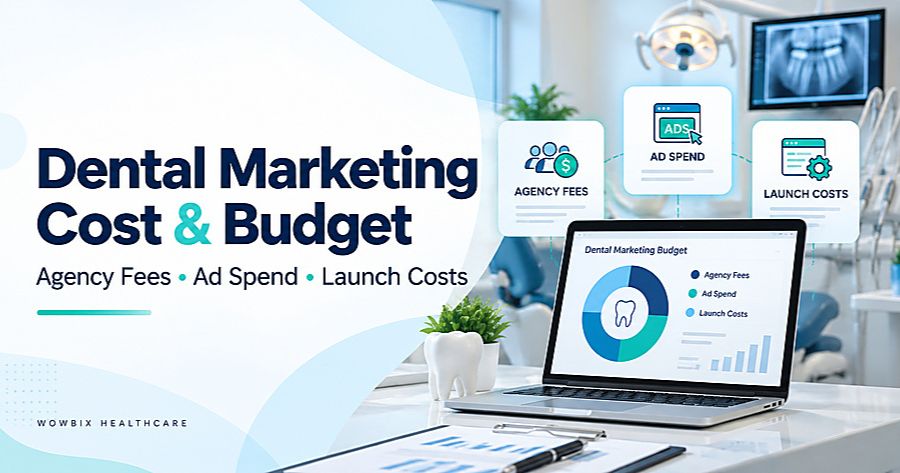
Dental marketing usually costs money in three distinct ways: ongoing agency fees, media spend paid to advertising platforms, and one-time website or launch expenses. Comparing agency proposals is difficult if those three amounts are combined into one unexplained monthly price.
Provider pricing pages checked in October 2026 show individual marketing services starting in the hundreds of dollars per month and broader multi-channel programs priced in the thousands. These are published provider examples, not a measured industry average. The right budget depends on your location, practice capacity, starting website, service mix and growth goal.
How Much Does Dental Marketing Cost?
Start by adding monthly agency or management fees and ad spend, then budget separately for one-time launch projects and software. For illustration, a $2,000 monthly agency fee plus $3,000 in Google Ads media spend creates a $5,000 recurring monthly commitment, before setup costs. It is an arithmetic example, not a Wowbix quotation or an industry benchmark.
Dental marketing costs at a glance
| Category | Pricing / structure | Timing | Pays for |
|---|---|---|---|
| Dental SEO | $500–$5,000+ per month in Wowbix editorial guidance | Recurring | Technical, local, content and reporting work |
| Google Ads management | Quote-based; often retainer, hybrid or share of ad spend | Recurring | Campaign execution, optimization and reporting |
| Google Ads media | Selected by the practice; $3,000/month in a hypothetical example | Recurring | Platform clicks and placements, not agency work |
| Dental website | Wowbix editorial guide: about $2,000–$8,000 simpler; $10,000–$20,000+ custom. Wowbix starts at $3,000. | Usually one-time | Design, content, development, integration |
| Dental social media | Wowbix published starting price: $499/month | Recurring | Specified organic social package; clarify paid media |
| Local SEO, paid social and full-service programs | Proposal-based; scope and channel mix vary | Recurring | Defined marketing services |
| Tracking, landing pages and setup | Project-based, request an itemized quote | Usually one-time; some software recurring | Implementation and measurement |
The ranges in the table are sourced to named providers or explicitly identified as planning examples. Dental SEO and website project ranges are estimates from Wowbix educational guides, not neutral surveyed averages. Any Wowbix starting price is labeled as the company’s own offer.
The Three Parts of a Dental Marketing Budget
1. Monthly agency or management fees
Agency fees pay for strategy, account management, SEO, local search work, content, campaign setup and optimization, reporting, analytics and other work specifically included in the contract. A retainer does not necessarily include every service. The proposal should state deliverables, frequency, responsible team, number of locations and what counts as additional work.
2. Paid advertising or media spend
Ad spend is money paid for Google Ads, Meta Ads or another advertising platform. It generally sits outside the management fee, even if the agency handles billing. Ask what amount is actually spent on the media platform, which account holds the campaign history and whether unused funds are returned or rolled over.
3. One-time launch and implementation
A website or redesign, branding, photography, landing pages, copywriting, initial SEO audit, Google Business Profile cleanup, tracking setup, call tracking, campaign build and software integration may carry separate project fees. A startup practice may need several items. An established practice might only need to repair tracking or develop one treatment landing page.
How Much Do Dental Marketing Agencies Charge?
Agency fees are often structured as a flat monthly retainer, a percentage of media spend, a defined project price, an hourly fee, or a hybrid incorporating performance. No pricing model guarantees quality. The main question is what work is included and what costs rise when the scope or ad budget changes.
How agency fee models differ
| Fee model | How it works | What to ask |
|---|---|---|
| Monthly retainer | Set monthly management payment | Deliverables, scope and location count? |
| Percentage of ad spend | Fee varies with media buying | Percentage, minimum, cap and billing basis? |
| Hybrid | Fixed minimum plus media/performance component | Which metrics, reporting rules and limits? |
| Project fee | Fixed quote for defined implementation | Revisions, ownership and change-order terms? |
| Hourly consulting | Time-based advisory or execution | Rate, estimate, scope and time reporting? |
As a worked example, a management fee equal to 15% of ad spend would be $450 on a $3,000 monthly media budget and $900 on a $6,000 budget. This demonstrates the calculation, not an industry-standard fee. Ask about any minimum charge, cap, setup fee and reporting requirements.
How Much Should a Dentist Spend on Google Ads?
There is no universal monthly amount. Build a test budget around the procedures you intend to promote, geography, expected search demand, cost per qualified inquiry, open appointments and the number of inquiries needed for a useful evaluation. A general dentist targeting nearby emergency visits has different economics from a multi-office implant campaign.
Separate three line items in the advertising proposal: the Google Ads media allowance, campaign management and any landing-page or tracking setup. For example, a $1,000 management fee plus $4,000 in ad spend means a $5,000 monthly PPC commitment. Wowbix healthcare PPC services describe the management work, but project-specific scope requires a proposal.
Healthcare-related targeting can have special limits. Check the official Google Ads health-related personalized advertising policy before assuming a proposed audience or remarketing tactic is permissible.
How Much Does Dental SEO Cost?
Wowbix’s dental SEO cost guide describes a broad $500 to $5,000-plus monthly planning range, depending on whether work involves limited maintenance or competitive ongoing SEO across many services or locations. This is Wowbix’s published editorial range, not a measured industry average or an automatic quote. Review dental SEO services and local SEO for dentists for the work that may sit behind a retainer.
How Much Does a Dental Website Cost?
Wowbix’s dental website cost guide discusses approximately $2,000 to $8,000 for a simpler professional website and $10,000 to $20,000-plus for more extensive custom development. The guide also publishes a Wowbix dental website starting price of $3,000, subject to the actual scope. These are editorial planning examples and a provider starting price, not a national average. The American Dental Association’s website cost guidance likewise explains why costs change with functionality, vendor and project scope.
Get an itemized estimate that specifies design, copywriting, pages, appointment integration, hosting, maintenance, accessibility and ownership. A redesign does not automatically improve rankings or deliver patients. Budget for content, local visibility and lead tracking after launch. Compare the scope offered under dental website design services.
What About Social Media, Reputation and Content Costs?
Separate organic social management, paid social management and the money used to buy paid social ads. Wowbix’s dental social media marketing page advertises packages starting at $499 per month; confirm the current posting frequency, video needs, channel scope and whether advertising is separate.
Reputation tools, review-request workflows and third-party software may add recurring charges. Dental content can be included in an SEO retainer or priced separately per article or page; make clinical review part of the scope.
What One-Time Launch Costs Should You Plan For?
Required launch investments depend on what exists already. Common essentials are a functional website or landing page, correct practice details, Google Business Profile basics, scheduling/contact paths and trustworthy analytics. An initial campaign may need ad account setup, conversion tracking, landing-page copy and creative. Optional items include a full rebrand, professional video, additional treatment pages, sophisticated automations and a redesign that the existing website does not actually need.
Ask whether each cost is included in the retainer, invoiced as a separate project or built into a minimum-term agreement. Wowbix’s Sun Dental website redesign and SEO case study demonstrates a website and search-foundation project; it should not be treated as proof of an unpublished patient-acquisition or return-on-investment figure.
What Does a Real Dental Marketing Budget Look Like?
| Scenario | Monthly agency | Monthly ad spend | One-time launch | Illustrative first year |
|---|---|---|---|---|
| New practice | $2,000 | $2,000 | $8,000 | $56,000 |
| Established single office | $2,500 | $2,500 | $1,500 | $61,500 |
| Competitive growth campaign | $4,000 | $6,000 | $4,000 | $124,000 |
| Specialty-focused office | $3,500 | $7,000 | $5,000 | $131,000 |
| Multi-location group | $7,000 | $12,000 | $15,000 | $243,000 |
All entries are deliberately hypothetical planning scenarios, not market averages or Wowbix offers.
All five scenarios are hypothetical U.S. planning models, not typical budgets, agency price quotes or recommended minimums. For each scenario, monthly agency fees, paid media and one-time setup are separate. Annual figures use 12 equal months and exclude software, tax and internal staff expenses.
First-year marketing investment = one-time costs + (12 × monthly agency fees) + (12 × monthly ad spend) + annual software and recurring technology charges. For the established single-location scenario below: $1,500 + (12 × $2,500) + (12 × $2,500) = $61,500, before software. This is cost arithmetic, not a revenue forecast.
How Should a New Dental Practice Budget for Marketing?
A startup office may need branding, an accurate website, treatment and location pages, a Google Business Profile, launch photography, measurement and paid campaigns. Treat infrastructure and campaign launch as one-time projects and SEO or campaign optimization as recurring programs. Time media spending around when staff can answer calls and appointments are actually available. Avoid producing leads that the practice cannot schedule.
How Should an Established Practice or Multi-Location Group Budget?
First diagnose the bottleneck: rankings, site conversion, response time, patient capacity or a lack of properly qualified inquiries. The correct spend may be on conversion repairs and attribution rather than a full website replacement. Where ongoing search is appropriate, combine local pages and other digital marketing strategies for dentists without buying duplicate deliverables.
Multi-location practices may need separate location pages, Google Business Profiles, ad markets and location-level reporting; shared assets can reduce duplicative work, so fees need not scale as a simple multiple of office count. Higher-value procedures, including dental implant marketing, can justify different keyword, landing-page and appointment-follow-up needs, but larger case values do not guarantee better returns.
How Do You Know Whether a Dental Marketing Budget Is Working?
Report more than clicks, impressions and raw leads. Track qualified calls and forms, answered calls, booked appointments, attended visits, treatment acceptance and revenue or contribution attributable to marketing. Missed calls, slow follow-up, insurance mismatches and appointment availability may reduce results after an otherwise legitimate lead arrives.
Marketing acquisition cost per new patient = total relevant marketing expense divided by the number of new patients reasonably attributed to that expense. If a practice spends $6,000 and attributes 20 new patients, the calculated cost is $300 per new patient. Both numbers are hypothetical, and attribution should use the practice’s own reliable data.
Marketing ROI = (attributable return minus marketing cost) ÷ marketing cost. Define return clearly. Revenue, collections, gross profit and forecast patient lifetime value are different measures. Profit-based analysis should include the cost of treating patients, and future patient value should not be represented as revenue already earned.
Increase spend when attribution is credible, patient capacity exists and cost per booked or acquired patient is economically sound. If tracking is unreliable, lead quality is weak, phones are unanswered or appointments are unavailable, resolve those issues before raising the media budget.
What Should a Dental Marketing Proposal Include?
A useful proposal states monthly activities, deliverables, reporting frequency, clinical content approvals, media budget, setup projects, software expenses, location surcharges and the source of each measurement. Check whether copywriting, landing pages, call tracking, reputation software, hosting and campaign creative are in the quote or billed separately.
Confirm that the practice controls its domain, site, content, creative files, Google Ads account, Google Business Profile, analytics and tracking history. Understand which assets transfer when the contract ends. Review term length, automatic renewal, cancellation notice, migration costs and licensing restrictions. A longer SEO or website agreement is not necessarily wrong, but the work and exit terms should justify it. You can also compare dental SEO companies using consistent scope questions.
Patient data introduces an additional implementation question. If call tracking, CRM, review software or advertising workflows receive protected health information, assess what data flows to each provider and whether appropriate agreements and controls are required. See official HHS HIPAA marketing guidance. Do not assume that a platform is automatically appropriate for all patient data.
How Wowbix Approaches Dental Marketing Budgets
Wowbix publishes dental marketing services covering search visibility, website development, paid campaigns and social media. A responsible proposal should consider the current website, local market, priority procedures, patient capacity, existing channels and conversion measurement, while separating agency labor, media spend and launch costs. The public prices for individual services should not be interpreted as a quote for a combined custom program.
Build a Dental Marketing Budget Around Your Practice
Share your practice location, core treatments, website, existing marketing investment, available appointment capacity and growth objective. Ask for a plan that itemizes recurring management fees, platform advertising and one-time setup work and explains how booked appointments will be measured.
Dental Marketing Cost FAQs
Is ad spend included in an agency retainer?
Not automatically. An agency retainer pays for defined management work. Money paid to Google or Meta is the media budget, whether separately invoiced or passed through the agency. Ask for a breakdown.
Should a dentist set marketing at a fixed percentage of revenue?
A percentage can help frame affordability, but it cannot substitute for assessing margins, appointment capacity, growth stage, local competition and the cost of acquiring a qualified patient. No one percentage fits every practice.
What does a dental marketing retainer include?
Only the work specified in the contract. It can include strategy, SEO, advertising management, content, local SEO and reporting, but content quantity, campaign platforms, extra locations and technology subscriptions must be explicit.
How long should a dentist test Google Ads?
Long enough to collect a useful volume of qualified inquiries and appointment outcomes, but not according to a guaranteed universal timeframe. Verify tracking from day one, then evaluate search terms, lead quality, booking and acquisition costs.
Is dental SEO or PPC a better use of budget?
SEO builds organic and local visibility over time and requires ongoing investment. PPC buys visibility while ads are running and can provide faster demand feedback, but campaign performance still depends on competition, landing pages, tracking and follow-up. The mix depends on timing and economics.
What is a good cost per new dental patient?
One that produces a sustainable result after considering the practice’s margins, attendance, treatment mix and retention. Calculate with actual marketing costs and reliably attributed new patients, rather than relying on a generic cost-per-lead figure.