
Most patients don’t call their doctor’s office based on referrals anymore. They search Google first. If your medical practice isn’t showing up on page one of search results, you’re missing the moment when a patient is actively looking for care and ready to book an appointment.
The good news? Getting to page one is achievable. It takes strategy, consistency, and the right approach—but it’s not impossible, even in competitive markets.
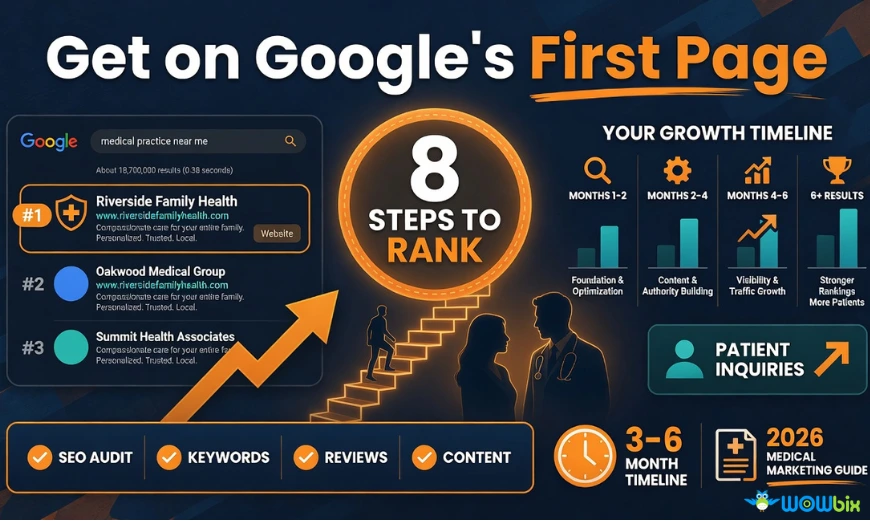
Here’s exactly how to get your medical practice ranking on Google’s first page.
- 1. Audit Your Current Website SEO Foundation
- 2. Target the Right Keywords for Medical Practices
- 3. Optimize Your Google Business Profile
- 4. Create Content That Answers Patient Questions
- 5. Build Local Authority Signals
- 6. Fix Technical SEO Issues
- 7. Build Your Review Profile
- 8. Track Progress and Adjust
- How Long Does This Take?
- The Shortcut: Hire a Healthcare SEO Agency
- Ready to Get Your Practice Ranking?
1. Audit Your Current Website SEO Foundation
Before you can improve your rankings, you need to know where you stand.
Start with a thorough website audit. Look at:
Technical Performance Check your page speed. Slow websites rank lower and lose patients. Use Google PageSpeed Insights to see where your site stands. Mobile responsiveness matters too—most patients search on phones.
Current Rankings Search for your practice by name and location. What keywords are you already ranking for? Are you on page one, page three, or nowhere? This baseline tells you what’s working and what needs fixing.
Broken Links and Errors Crawl your site for broken links, missing images, and technical errors. Google’s crawlers should be able to navigate your site easily. If they can’t, your rankings suffer.
Content Gaps Look at what pages you have and what you’re missing. Do you have dedicated pages for each service you offer? A blog? Patient FAQ section? Gaps here are lost ranking opportunities.
This audit is your starting point. Everything else builds from here.
2. Target the Right Keywords for Medical Practices
Not all keywords are equal. The wrong keyword strategy wastes months of work.
Local Keywords Come First
Your patients are local. They search “dentist near me,” “orthopedic surgeon in [city],” “pediatrician accepting new patients.” Focus on local keywords first. These have high intent (people ready to book) and less competition than national terms.
High-Intent Keywords Beat Volume
A keyword with 100 monthly searches for “emergency root canal near me” is worth more than 10,000 searches for “what is a root canal.” One person is ready to book. The other is just learning.
Service + Location = Your Keyword Strategy
The winning formula: [service] + [location]. “Dermatologist in Denver.” “Best orthodontist in Austin.” “Cardiologist accepting new patients in Portland.” These keywords convert.
Use Keyword Research Tools
Google Search Console shows you what people are already searching for when they find your site. Use it. Tools like Semrush, Ahrefs, or Moz show you monthly search volume and competition levels for keywords in your market.
Don’t chase keywords with zero local search volume. Focus on what your actual patients are searching for in your area.
3. Optimize Your Google Business Profile
Your Google Business Profile is often the first thing patients see. Get this wrong and you’ve already lost.
Claim and Verify Your Profile
If you haven’t already claimed your profile, do it now. Go to Google Business Profile, search for your practice, claim it, and complete the verification process (usually a postcard mailed to your address).
Fill Out Every Section
Don’t leave fields blank. Complete your business categories, add all services you offer, upload photos of your office and staff, list your hours, add appointment links, and include your phone number prominently.
Keep Information Accurate and Updated
Inconsistent information confuses both Google and patients. If your website says you’re open until 6pm but your Google profile says 5pm, patients will be frustrated. Update everything when things change—hours, services, location.
Add Service Areas if You’re Multi-Location
If you have multiple offices, create separate profiles for each location. Each gets its own local presence and ranking opportunity.
Use High-Quality Photos
Clear, professional photos of your office, team, and treatment rooms build trust. Patients want to know what to expect. Photos help with that.
4. Create Content That Answers Patient Questions
Google rewards websites that answer patient questions. Your competitors probably aren’t doing this well. This is your advantage.
Write Service Pages for Every Treatment You Offer
If you offer implants, root canals, whitening, or braces—create dedicated pages for each. Each page should answer: What is this? Why might you need it? What’s the process? How much does it cost? What results should you expect?
These pages rank for specific search queries (“dental implants near me,” “how much do braces cost”). They also convert because patients get their questions answered.
Create Blog Posts on Common Patient Concerns
What do patients ask about most? Write about it. “What to expect at your first appointment.” “Do I really need this procedure?” “Recovery time after surgery.” “Is this covered by insurance?”
These aren’t sales pitches. They’re answers. Google ranks content that actually helps people. Patients trust practices that educate, not sell.
Answer “How Much” Questions
Patients want to know cost. Don’t hide it. Create content addressing pricing questions for your top services. Transparency builds trust and ranks well.
Focus on Your Specialty
A general practitioner’s content strategy is different from a specialist’s. Orthodontists need before-and-after content. Surgeons need procedure education. Dermatologists need condition guides. Write for your specific practice type.
5. Build Local Authority Signals
Google uses local signals to decide who ranks in your area. The more signals you have, the higher you rank.
Maintain Consistent NAP Across Directories
NAP = Name, Address, Phone. This information should be identical everywhere: your website, Google Business Profile, Yelp, industry directories, local listings. Inconsistencies tell Google you’re not legitimate.
If you’re listed as “Dr. John Smith’s Dental Practice” on your website but “John Smith Dentistry” on Yelp, that’s a problem. Be consistent.
Get Quality Backlinks
Links from reputable healthcare websites, local organizations, and industry directories act as “votes of confidence” for Google. You’re not going to get these by accident.
Pitch local press for mentions. Get listed in healthcare directories. Ask patient referral partners to link to you. These earned links build authority.
Encourage and Respond to Reviews
Reviews are both a ranking factor and a patient decision factor. More reviews with higher ratings = higher rankings. Patients also trust practices with lots of reviews.
Ask satisfied patients to leave reviews on Google, Yelp, and Healthgrades. Respond to all reviews—positive and negative. Quick, professional responses show you care about feedback.
6. Fix Technical SEO Issues
Technical SEO doesn’t excite most practice owners, but Google cares deeply about it.
Improve Page Speed
A page that takes 5 seconds to load ranks lower than one that loads in 2 seconds. Use Google PageSpeed Insights to identify issues. Compress images. Minimize code. Use a CDN. Speed matters for both rankings and patient experience.
Ensure Mobile Responsiveness
Most patients search on phones. If your website isn’t mobile-friendly, you’re ranked lower. Google prioritizes mobile-first indexing. Make sure everything works smoothly on smartphones and tablets.
Fix Site Structure
Your site should have a logical hierarchy. Homepage → Service Categories → Individual Services → Blog. Clear internal linking helps Google understand your content and helps patients navigate.
Add Schema Markup
Schema markup tells Google what your content is about. Medical practice schema, service schema, review schema—these help Google understand and rank your content better.
You don’t need to understand code to do this. Most website builders and SEO plugins handle schema markup for you.
7. Build Your Review Profile
Reviews affect both rankings and patient decisions. They’re critical.
Ask Satisfied Patients for Reviews
After successful treatments, ask patients to leave reviews. Make it easy—provide direct links to Google, Yelp, Healthgrades. Follow up via email or text.
Most patients don’t leave reviews unprompted. You have to ask.
Respond to Every Review
Positive reviews: Thank the patient. Mention specific details from their review. Show you read it.
Negative reviews: Respond professionally. Don’t argue. Acknowledge their concern. Offer to fix the problem. This shows you take feedback seriously.
Google’s algorithm notices response rates. Active, engaged practices rank higher.
Monitor Your Review Profile
Check monthly. How many reviews do you have? What’s your average rating? Are you getting more positive or negative feedback? This tells you what’s working and what needs improvement.
8. Track Progress and Adjust
You can’t improve what you don’t measure.
Monitor Keyword Rankings Monthly
Where are you ranking for your target keywords? Track this monthly. You should see movement within 3-6 months. If you’re stuck after 6 months, your strategy needs adjustment.
Track Organic Traffic and Patient Inquiries
Website traffic is nice, but it doesn’t pay bills. What matters: How many patients are calling from organic search? How many are booking appointments? How many are becoming patients?
Set up conversion tracking in Google Analytics. Connect your phone number to call tracking. Know exactly which keywords bring actual patient inquiries.
Don’t Just Look at Vanity Metrics
Traffic numbers look good in reports but mean nothing if they don’t convert to patients. Focus on the metric that matters: new patient acquisitions from organic search.
Adjust Based on Results
If certain keywords rank well but don’t convert, deprioritize them. If other keywords bring patient calls, invest more there. SEO is ongoing optimization, not set-it-and-forget-it.
How Long Does This Take?
Most medical practices see ranking improvements within 3-6 months. Here’s a realistic timeline:
Months 1-2: Technical fixes and foundational work. You’re building the platform, not yet seeing major ranking movement.
Months 2-4: Rankings start climbing for less competitive keywords. You might see some organic traffic.
Months 4-6: Competitive keyword rankings improve. Patient inquiries from organic search increase.
Month 6+: Momentum builds. As your authority grows, rankings accelerate. You might rank for keywords you didn’t even target.
Timeline varies based on competition. A less competitive market might see results in 2-3 months. Highly competitive cities like New York or Los Angeles might take 6-9 months.
The key: Be patient and consistent. Most practices quit after 3 months when they don’t see immediate results. The ones who stick with it for 6+ months win.
The Shortcut: Hire a Healthcare SEO Agency
Here’s the reality: Getting your practice to page one while running a medical practice is a lot of work.
You have patients to see. Staff to manage. Business to run. Adding SEO to your plate is tough.
An experienced healthcare SEO agency can:
Do the technical work faster. They know the shortcuts and tools. What takes you months takes them weeks.
Know what actually works in medical markets. Not all SEO is created equal. Healthcare markets have unique challenges. An agency that specializes in medical practices knows these nuances.
Save you months of trial and error. They’ve done this hundreds of times. They know what works and what doesn’t. You don’t have to figure it out yourself.
Track ROI directly to patient acquisition. A good agency ties every metric back to new patient calls and appointments. You see the connection between the work and your revenue.
Keep up with algorithm changes. Google updates its algorithm constantly. Agencies stay current. You don’t have to.
Ready to Get Your Practice Ranking?
If you’re ready to stop losing patients to competitors who rank higher, it’s time to take action.
The good news: You don’t have to figure this out alone.
Get a free SEO audit of your medical practice. We’ll analyze where you currently rank, identify what’s holding you back, and show you exactly what it takes to get to page one.
No obligation. No sales pitch. Just real data about your practice’s search visibility.
Ready to get started? Schedule your free audit today.